

Signing of the Refugee Convention
Photograph
Image
Video
Audio
 Activities
LOOK
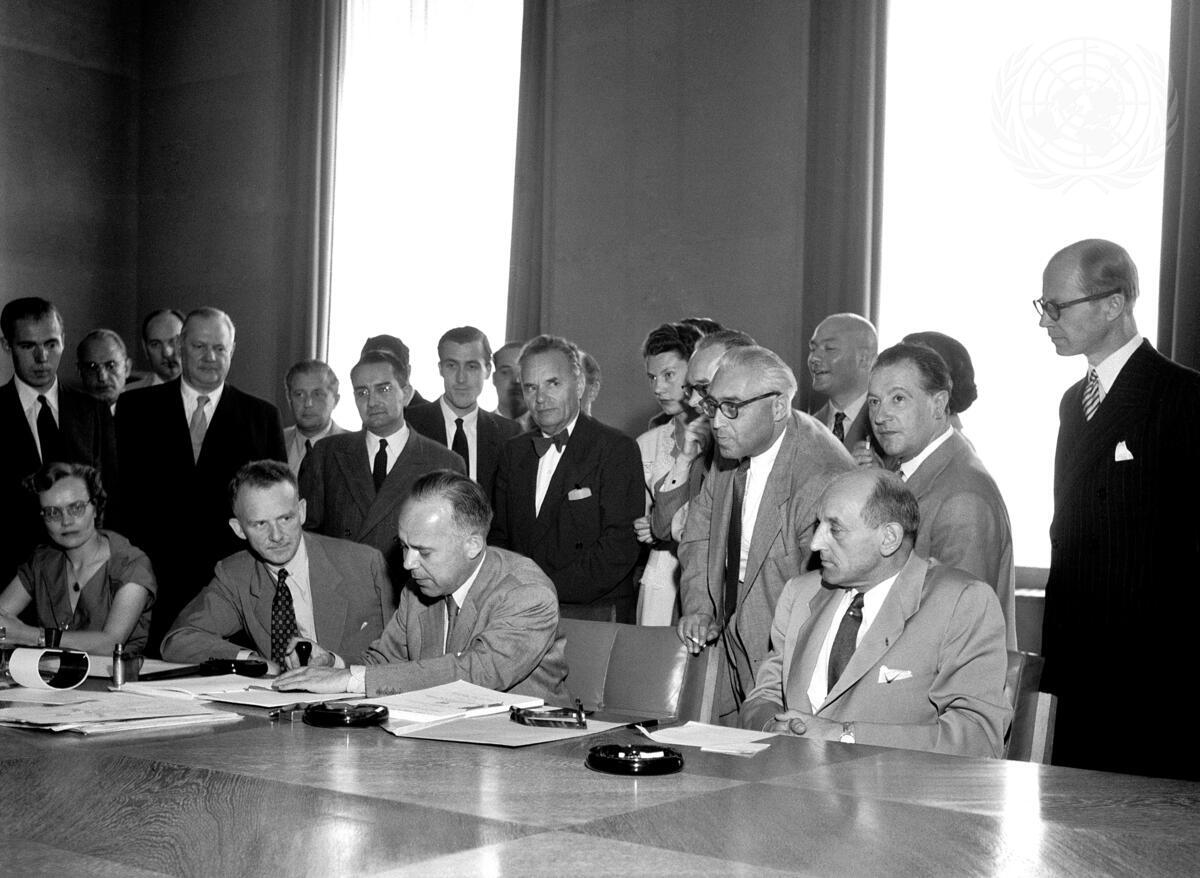
Examine the photograph and information provided. Notice the setting, the people involved, and the significance of their actions.
Focus on the details:
- Where is this event taking place?
- Who are the key figures present?
- What are they doing, and what might the documents represent?
THINK
Why might certain nations, including Canada, have chosen not to sign the Convention at the time?
DO
Conduct a research project on Canada’s eventual adoption of the Refugee Convention (1969). What events or pressures led to the change?
Details
 Date July 28, 1951
 Materials
 - Photograph
Historical Context
Choose one of the three levels below to match your needs.
- This photograph depicts representatives from several countries signing the 1951 United Nations Convention that gave protection to refugees.
- Canada was not one of these countries. The government did not want to give up any control of immigration, and did not sign for almost 20 years.
- For more context, read about the United Nations, particularly its Convention on Refugees.
This photograph depicts representatives from several countries signing the 1951 United Nations Convention that gave protection to refugees.
Canada did not ratify the convention until almost 20 years later. Canada stood in contrast to other countries that accepted many refugees.
Within a global perspective, Canada’s refusal to sign indicates a reluctance to integrate completely into the international order that followed the Second World War.
This photograph depicts representatives from several countries, signing the 1951 United Nations Convention that gave protection to refugees.
On July 28, 1951, at the Palais des Nations in Geneva, 12 nations signed the Convention Relating to the Status of Refugees. The Convention was drafted by the World Conference on Refugees and Stateless Persons, which met in Geneva from July 2 to 25 that year.
The countries that signed were Austria, Belgium, Colombia, Denmark, Luxembourg, the Netherlands, Norway, Sweden, Switzerland, Liechtenstein, the United Kingdom and Yugoslavia. Israel signed later. No representative of Canada signed the convention at the time.
Seated at the table (left to right): Margaret Kitchen, Deputy Executive Secretary; John Humphrey, Director of the Human Rights Division; Knud Larsen (Denmark), President of the Conference; and Dr. G.J. Van Heuven Goedhart, High Commissioner for Refugees.
- This photograph depicts representatives from several countries signing the 1951 United Nations Convention that gave protection to refugees.
- Canada was not one of these countries. The government did not want to give up any control of immigration, and did not sign for almost 20 years.
- For more context, read about the United Nations, particularly its Convention on Refugees.
This photograph depicts representatives from several countries signing the 1951 United Nations Convention that gave protection to refugees.
Canada did not ratify the convention until almost 20 years later. Canada stood in contrast to other countries that accepted many refugees.
Within a global perspective, Canada’s refusal to sign indicates a reluctance to integrate completely into the international order that followed the Second World War.
This photograph depicts representatives from several countries, signing the 1951 United Nations Convention that gave protection to refugees.
On July 28, 1951, at the Palais des Nations in Geneva, 12 nations signed the Convention Relating to the Status of Refugees. The Convention was drafted by the World Conference on Refugees and Stateless Persons, which met in Geneva from July 2 to 25 that year.
The countries that signed were Austria, Belgium, Colombia, Denmark, Luxembourg, the Netherlands, Norway, Sweden, Switzerland, Liechtenstein, the United Kingdom and Yugoslavia. Israel signed later. No representative of Canada signed the convention at the time.
Seated at the table (left to right): Margaret Kitchen, Deputy Executive Secretary; John Humphrey, Director of the Human Rights Division; Knud Larsen (Denmark), President of the Conference; and Dr. G.J. Van Heuven Goedhart, High Commissioner for Refugees.
Summary
- This photograph depicts representatives from several countries signing the 1951 United Nations Convention that gave protection to refugees.
- Canada was not one of these countries. The government did not want to give up any control of immigration, and did not sign for almost 20 years.
- For more context, read about the United Nations, particularly its Convention on Refugees.
Essential
This photograph depicts representatives from several countries signing the 1951 United Nations Convention that gave protection to refugees.
Canada did not ratify the convention until almost 20 years later. Canada stood in contrast to other countries that accepted many refugees.
Within a global perspective, Canada’s refusal to sign indicates a reluctance to integrate completely into the international order that followed the Second World War.
In-Depth
This photograph depicts representatives from several countries, signing the 1951 United Nations Convention that gave protection to refugees.
On July 28, 1951, at the Palais des Nations in Geneva, 12 nations signed the Convention Relating to the Status of Refugees. The Convention was drafted by the World Conference on Refugees and Stateless Persons, which met in Geneva from July 2 to 25 that year.
The countries that signed were Austria, Belgium, Colombia, Denmark, Luxembourg, the Netherlands, Norway, Sweden, Switzerland, Liechtenstein, the United Kingdom and Yugoslavia. Israel signed later. No representative of Canada signed the convention at the time.
Seated at the table (left to right): Margaret Kitchen, Deputy Executive Secretary; John Humphrey, Director of the Human Rights Division; Knud Larsen (Denmark), President of the Conference; and Dr. G.J. Van Heuven Goedhart, High Commissioner for Refugees.