

Privy Council Meeting Minutes
Document
Image
Video
Audio
 Activities
LOOK
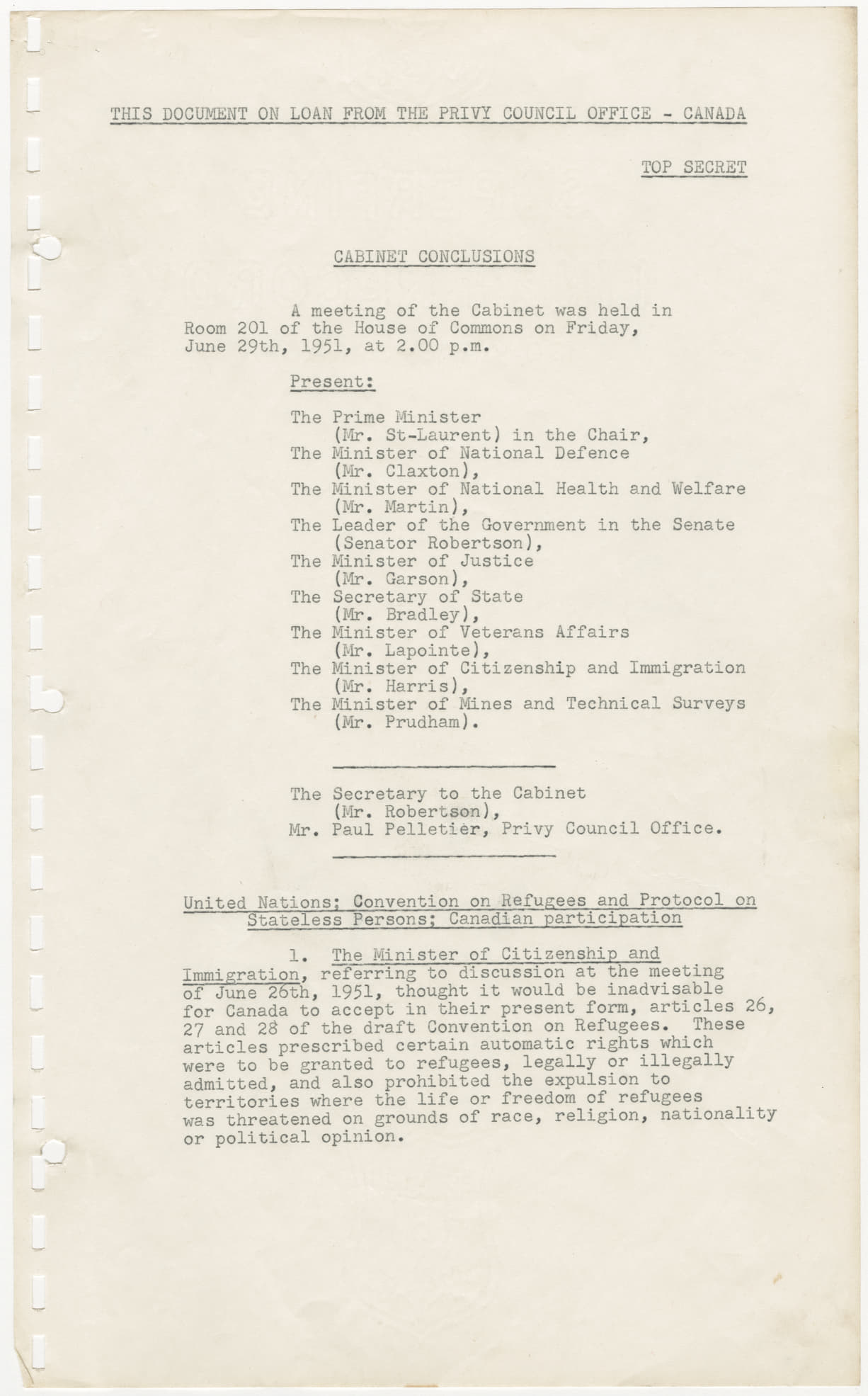
Read the minutes of the Privy Council meeting and summarize the main points.
THINK
Why is it important to have an official and recognized definition of the term “refugee”?
DO
Create a short “Refugee Rights Charter,” outlining what you believe Canada’s refugee policies should prioritize today.
Details
 Date June 29, 1951
 Materials
 - Paper
- Ink
Historical Context
Choose one of the three levels below to match your needs.
- This document details the minutes of a federal Cabinet meeting in 1951.
- During this meeting of Prime Minister St-Laurent’s Cabinet, members of Parliament discussed their approach to the legal status of refugees.
- The United Nations created a definition of “refugee” in 1951.
- The Canadian government did not accept new UN rules that granted special status to refugees until 1969.
- Background knowledge of the purpose of the United Nations would be helpful, particularly when it comes to why the UN was concerned about refugees in the 1950s.
This document details the minutes of a federal Cabinet meeting in 1951.
According to these minutes, Prime Minister Louis St-Laurent and his Cabinet were reluctant to adopt the United Nations definition of “refugee.” That year, the UN had created a new legal status for refugees, separate from the status for other migrants.
Canada’s government argued that this country had to have absolute control over its immigration policy. The UN drafted the Convention in 1951, but Canada did not sign it until 1969.
These minutes offer a snapshot of a certain Canadian perspective on sovereignty, immigration and potentially “undesirable” refugees.
This document details the minutes of a federal Cabinet meeting in 1951.
For most of its history, Canada had no official definition of refugee. Refugees were simply considered immigrants.
Officials and the public sometimes showed pity and compassion to those fleeing violence. However, refugees were most often welcomed only when they suited Canada’s needs for labour and settlement.
In 1951, a United Nations conference in Geneva, dealing with millions of European refugees from the Second World War, created a definition of refugee. “The Convention Definition,” with amendments, still guides refugee decisions and policy all over the world.
Although the United Nations drafted the Convention in 1951, Canada did not ratify it until 1969. The Canadian government was concerned about its ability to deport refugees who were deemed undesirable, especially those who might threaten security.
Since the 1950s, more than 140 countries have ratified the Convention.
- This document details the minutes of a federal Cabinet meeting in 1951.
- During this meeting of Prime Minister St-Laurent’s Cabinet, members of Parliament discussed their approach to the legal status of refugees.
- The United Nations created a definition of “refugee” in 1951.
- The Canadian government did not accept new UN rules that granted special status to refugees until 1969.
- Background knowledge of the purpose of the United Nations would be helpful, particularly when it comes to why the UN was concerned about refugees in the 1950s.
This document details the minutes of a federal Cabinet meeting in 1951.
According to these minutes, Prime Minister Louis St-Laurent and his Cabinet were reluctant to adopt the United Nations definition of “refugee.” That year, the UN had created a new legal status for refugees, separate from the status for other migrants.
Canada’s government argued that this country had to have absolute control over its immigration policy. The UN drafted the Convention in 1951, but Canada did not sign it until 1969.
These minutes offer a snapshot of a certain Canadian perspective on sovereignty, immigration and potentially “undesirable” refugees.
This document details the minutes of a federal Cabinet meeting in 1951.
For most of its history, Canada had no official definition of refugee. Refugees were simply considered immigrants.
Officials and the public sometimes showed pity and compassion to those fleeing violence. However, refugees were most often welcomed only when they suited Canada’s needs for labour and settlement.
In 1951, a United Nations conference in Geneva, dealing with millions of European refugees from the Second World War, created a definition of refugee. “The Convention Definition,” with amendments, still guides refugee decisions and policy all over the world.
Although the United Nations drafted the Convention in 1951, Canada did not ratify it until 1969. The Canadian government was concerned about its ability to deport refugees who were deemed undesirable, especially those who might threaten security.
Since the 1950s, more than 140 countries have ratified the Convention.
Summary
- This document details the minutes of a federal Cabinet meeting in 1951.
- During this meeting of Prime Minister St-Laurent’s Cabinet, members of Parliament discussed their approach to the legal status of refugees.
- The United Nations created a definition of “refugee” in 1951.
- The Canadian government did not accept new UN rules that granted special status to refugees until 1969.
- Background knowledge of the purpose of the United Nations would be helpful, particularly when it comes to why the UN was concerned about refugees in the 1950s.
Essential
This document details the minutes of a federal Cabinet meeting in 1951.
According to these minutes, Prime Minister Louis St-Laurent and his Cabinet were reluctant to adopt the United Nations definition of “refugee.” That year, the UN had created a new legal status for refugees, separate from the status for other migrants.
Canada’s government argued that this country had to have absolute control over its immigration policy. The UN drafted the Convention in 1951, but Canada did not sign it until 1969.
These minutes offer a snapshot of a certain Canadian perspective on sovereignty, immigration and potentially “undesirable” refugees.
In-Depth
This document details the minutes of a federal Cabinet meeting in 1951.
For most of its history, Canada had no official definition of refugee. Refugees were simply considered immigrants.
Officials and the public sometimes showed pity and compassion to those fleeing violence. However, refugees were most often welcomed only when they suited Canada’s needs for labour and settlement.
In 1951, a United Nations conference in Geneva, dealing with millions of European refugees from the Second World War, created a definition of refugee. “The Convention Definition,” with amendments, still guides refugee decisions and policy all over the world.
Although the United Nations drafted the Convention in 1951, Canada did not ratify it until 1969. The Canadian government was concerned about its ability to deport refugees who were deemed undesirable, especially those who might threaten security.
Since the 1950s, more than 140 countries have ratified the Convention.