

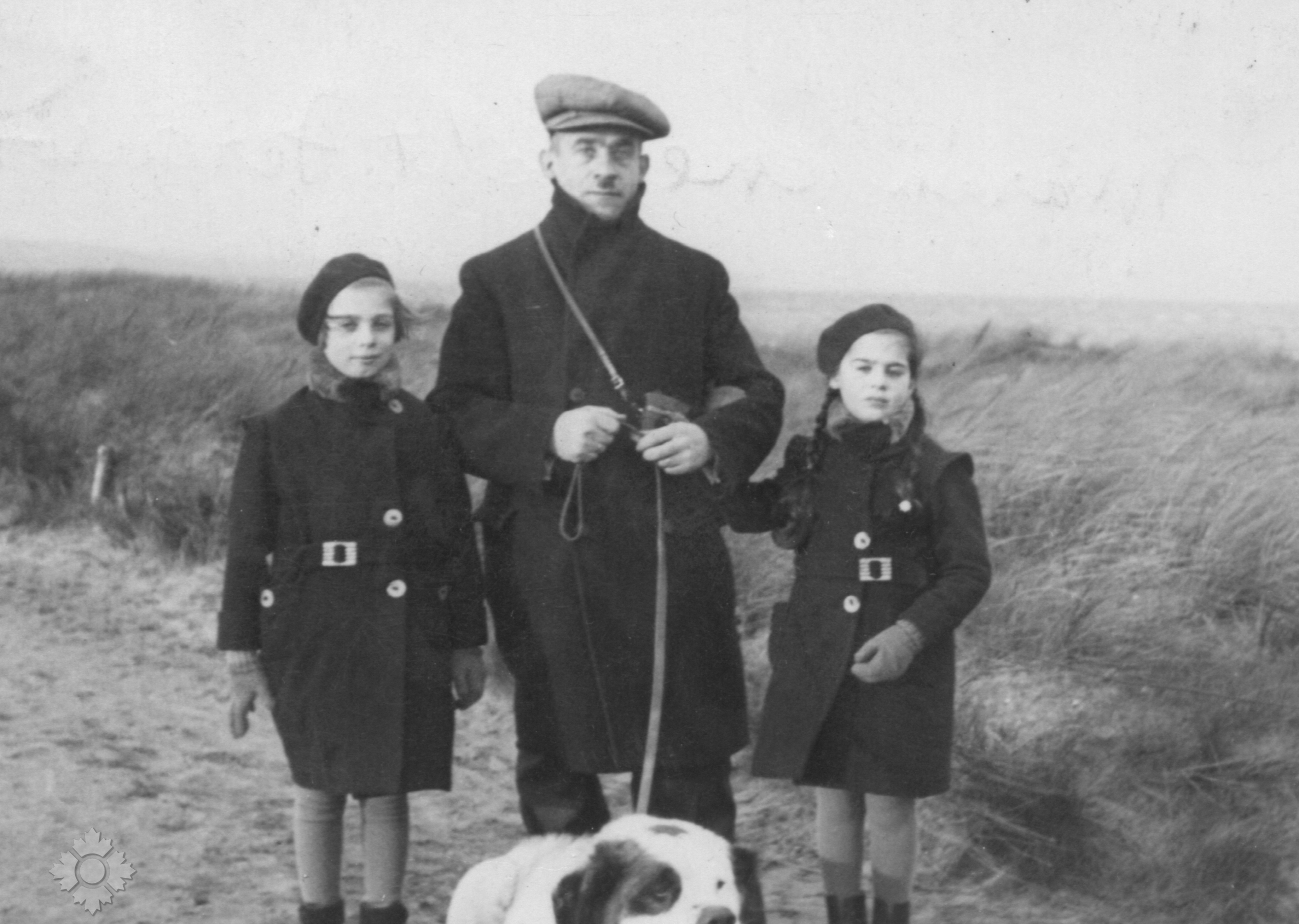
Photograph of the Echt Family
Photograph
Image
Video
Audio
 Activities
LOOK
Examine the photograph of Marianne Ferguson with her father and sister, taken in the 1930s. Discuss the family’s life before fleeing Nazi persecution, and their journey to Canada.
THINK
Marianne’s father was able to find a way to get his family into Canada, against the odds. Take a few moments to consider all the people who were not able to escape. How do you think Canada can learn from this chapter in history?
DO
Why do you think the Canadian government made it harder for Jewish immigrants to come to Canada before and during the Second World War? Read this article from The Canadian Museum for Human Rights, and share your insights with a partner.
Details
 Date c. 1935-1939
 Materials
 - Photograph
Historical Context
Choose one of the three levels below to match your needs.
- This photograph depicts Marianne Ferguson (left) with her father, Otto Echt (centre), and sister, Brigitte Echt (right), in the 1930s, before they fled to Canada.
- The photograph shows what and who was at risk, when the Canadian government denied entry to many Jewish refugees in the lead-up to the Second World War.
- Background understanding of the discrimination of Canada and other nations against Jewish refugees in the 1930s and 1940s is helpful.
This photograph depicts Marianne Ferguson (left) with her father, Otto Echt (centre), and sister, Brigitte Echt (right), in the 1930s, before they fled to Canada.
Although the Echt family managed to remain together during their refugee experience, many others were not so lucky. Canada’s restrictive immigration policies on Jewish refugees resulted in the separation of many families.
The Canadian government could have easily rejected Otto’s refugee claim. If that had been the case, he would have been left behind in Nazi-occupied Poland, and his family might have refused to leave without him.
From the perspective of his two young daughters, it is easy imagine how frightening the prospect of family separation would be.
This photograph depicts Marianne Ferguson (left) with her father, Otto Echt (centre), and sister, Brigitte Echt (right), in the 1930s, before they fled to Canada.
By the time Marianne’s family had decided to come to Canada to escape Nazi persecution, Canada was severely limiting Jewish immigration. An urgent international conference was convened at Évian-les-Bains, France, in 1938, to develop a collective response to the plight of Jews fleeing Nazism.
At the Évian Conference, Canadian Prime Minister Mackenzie King avoided any commitment to accept refugees. Canada also raised the financial requirements for Jewish immigrants from $5,000 to $20,000. Even those with enough funds to enter the country were often denied entry and, for a time, only Jewish farmers or doctors were allowed entry into Canada.
Marianne’s father, Otto Echt, was a pharmacist and businessman, and would not have been allowed to come with his family to Canada on those grounds. As a hobby, however, he kept a few farm animals, and was able to include his work as a “farmer” in his application, which was accepted. The family arrived at Pier 21 in Halifax, Nova Scotia on March 7, 1939.
- This photograph depicts Marianne Ferguson (left) with her father, Otto Echt (centre), and sister, Brigitte Echt (right), in the 1930s, before they fled to Canada.
- The photograph shows what and who was at risk, when the Canadian government denied entry to many Jewish refugees in the lead-up to the Second World War.
- Background understanding of the discrimination of Canada and other nations against Jewish refugees in the 1930s and 1940s is helpful.
This photograph depicts Marianne Ferguson (left) with her father, Otto Echt (centre), and sister, Brigitte Echt (right), in the 1930s, before they fled to Canada.
Although the Echt family managed to remain together during their refugee experience, many others were not so lucky. Canada’s restrictive immigration policies on Jewish refugees resulted in the separation of many families.
The Canadian government could have easily rejected Otto’s refugee claim. If that had been the case, he would have been left behind in Nazi-occupied Poland, and his family might have refused to leave without him.
From the perspective of his two young daughters, it is easy imagine how frightening the prospect of family separation would be.
This photograph depicts Marianne Ferguson (left) with her father, Otto Echt (centre), and sister, Brigitte Echt (right), in the 1930s, before they fled to Canada.
By the time Marianne’s family had decided to come to Canada to escape Nazi persecution, Canada was severely limiting Jewish immigration. An urgent international conference was convened at Évian-les-Bains, France, in 1938, to develop a collective response to the plight of Jews fleeing Nazism.
At the Évian Conference, Canadian Prime Minister Mackenzie King avoided any commitment to accept refugees. Canada also raised the financial requirements for Jewish immigrants from $5,000 to $20,000. Even those with enough funds to enter the country were often denied entry and, for a time, only Jewish farmers or doctors were allowed entry into Canada.
Marianne’s father, Otto Echt, was a pharmacist and businessman, and would not have been allowed to come with his family to Canada on those grounds. As a hobby, however, he kept a few farm animals, and was able to include his work as a “farmer” in his application, which was accepted. The family arrived at Pier 21 in Halifax, Nova Scotia on March 7, 1939.
Summary
- This photograph depicts Marianne Ferguson (left) with her father, Otto Echt (centre), and sister, Brigitte Echt (right), in the 1930s, before they fled to Canada.
- The photograph shows what and who was at risk, when the Canadian government denied entry to many Jewish refugees in the lead-up to the Second World War.
- Background understanding of the discrimination of Canada and other nations against Jewish refugees in the 1930s and 1940s is helpful.
Essential
This photograph depicts Marianne Ferguson (left) with her father, Otto Echt (centre), and sister, Brigitte Echt (right), in the 1930s, before they fled to Canada.
Although the Echt family managed to remain together during their refugee experience, many others were not so lucky. Canada’s restrictive immigration policies on Jewish refugees resulted in the separation of many families.
The Canadian government could have easily rejected Otto’s refugee claim. If that had been the case, he would have been left behind in Nazi-occupied Poland, and his family might have refused to leave without him.
From the perspective of his two young daughters, it is easy imagine how frightening the prospect of family separation would be.
In-Depth
This photograph depicts Marianne Ferguson (left) with her father, Otto Echt (centre), and sister, Brigitte Echt (right), in the 1930s, before they fled to Canada.
By the time Marianne’s family had decided to come to Canada to escape Nazi persecution, Canada was severely limiting Jewish immigration. An urgent international conference was convened at Évian-les-Bains, France, in 1938, to develop a collective response to the plight of Jews fleeing Nazism.
At the Évian Conference, Canadian Prime Minister Mackenzie King avoided any commitment to accept refugees. Canada also raised the financial requirements for Jewish immigrants from $5,000 to $20,000. Even those with enough funds to enter the country were often denied entry and, for a time, only Jewish farmers or doctors were allowed entry into Canada.
Marianne’s father, Otto Echt, was a pharmacist and businessman, and would not have been allowed to come with his family to Canada on those grounds. As a hobby, however, he kept a few farm animals, and was able to include his work as a “farmer” in his application, which was accepted. The family arrived at Pier 21 in Halifax, Nova Scotia on March 7, 1939.