

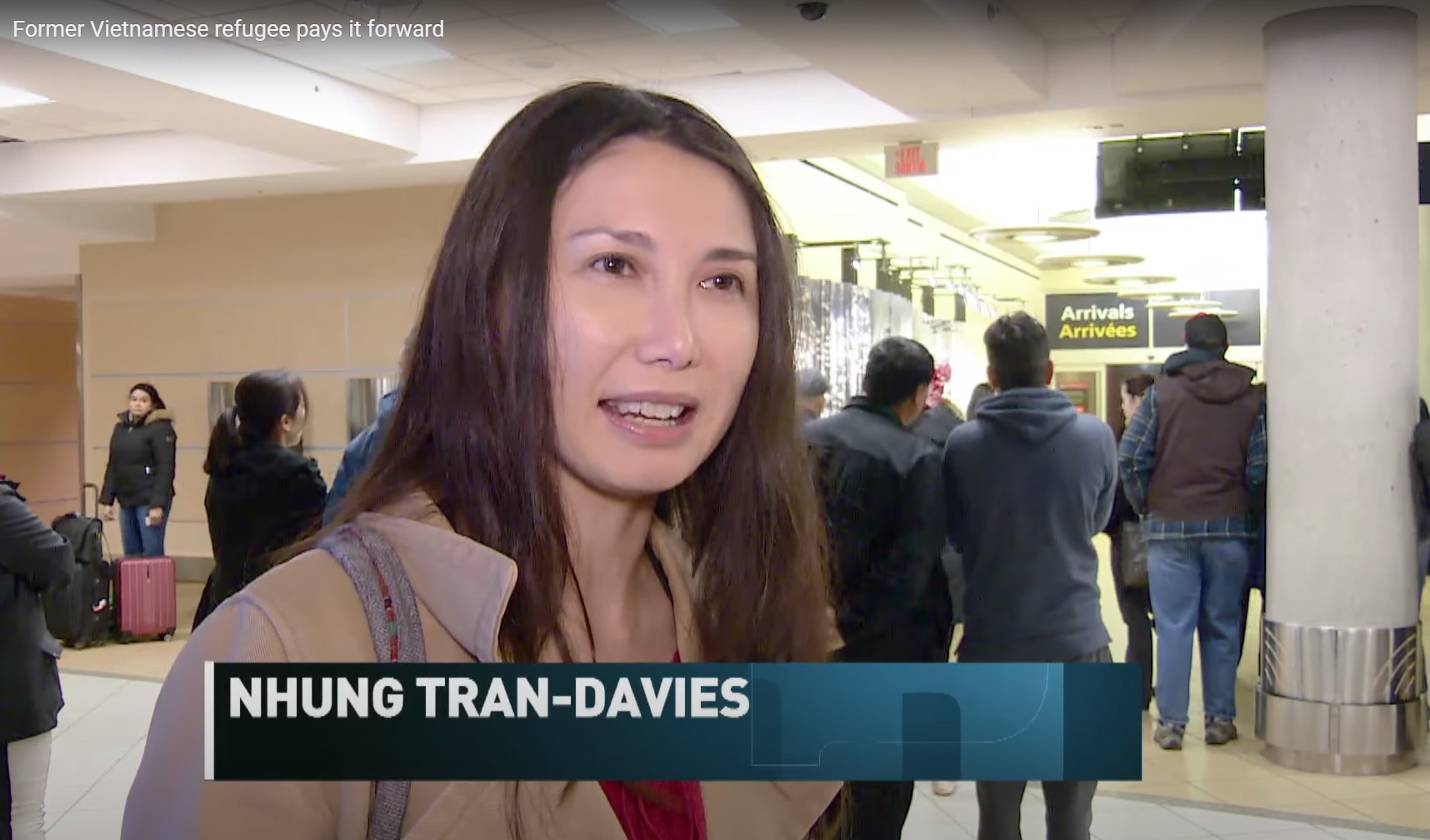
Former Vietnamese refugee pays it forward by sponsoring Syrian family
Photograph
Image
Video
Audio
 Activities
LOOK
Follow the link under “Institution” to examine the video and article about the arrival of Vietnamese and Syrian refugees in Canada. What emotions do you see on their faces? How do their experiences compare?
THINK
Why do you think private sponsorship was so successful in Canada? How does one act of kindness, like Nguyen Tran-Davies’ story, create lasting change?
DO
Write a letter to a refugee sponsor or organization, thanking them for their efforts and/or asking them how you can help support newcomers in your own community.
Details


Historical Context
Choose one of the three levels below to match your needs.
- The CBC reported on the story of Nguyen Tran-Davies, who was a Vietnamese refugee.
- Nguyen came to Canada in 1979, at just 5 years of age.
- Private Canadian citizens sponsored Nguyen and her family.
- Forty years later, Nguyen used the same sponsorship system to welcome a family from war-torn Syria.
- Her words and actions reveal the deep relationship many Canadians have with refugees.
The CBC reported on the story of Nguyen Tran-Davies, who was a Vietnamese refugee.
Nguyen was herself one of 60,000 refugees from the Vietnam War who came to Canada through private sponsorship. Forty years later, now a doctor, Nguyen used the same process to bring a family of Syrian refugees to Canada.
Nguyen’s story demonstrates the broader impact of earlier refugee policies. By allowing Nguyen and her family into Canada, the Canadian government helped to create a broader social safety net for more refugees in the future.
The CBC reported on the story of Nguyen Tran-Davies, who was a Vietnamese refugee.
After the fall of Saigon in April 1975, thousands of Vietnamese, Laotians and Cambodians fled across Southeast Asia. Referred to as “boat people” because many left in overcrowded boats, they were prey to rough seas and violence. Those who survived the ordeal found themselves in camps in Thailand and Malaysia.
In 1979, the Canadian government introduced a private sponsorship program. By 1980, more than 60,000 people had been resettled in Canada.
More than half of them were privately sponsored by churches and volunteer groups. Their permanent resettlement became the single most generous record of any country in proportion to its population.
Nguyen arrived in Canada in 1979, at just 5 years old, with her widowed mother and five siblings. The family was supported by an Alberta church group.
Nguyen later paid it forward by privately sponsoring a Syrian family. Now a doctor, she was deeply moved by the Syrian refugee crisis and, with the help of friends, raised funds to bring a mother and her five children to safety.
Nearly 40 years after receiving a welcome doll as a child, Nguyen greeted the Syrian family’s youngest member, Alma, with a doll of her own. The gesture symbolized the full-circle nature of Nguyen’s own journey.
- The CBC reported on the story of Nguyen Tran-Davies, who was a Vietnamese refugee.
- Nguyen came to Canada in 1979, at just 5 years of age.
- Private Canadian citizens sponsored Nguyen and her family.
- Forty years later, Nguyen used the same sponsorship system to welcome a family from war-torn Syria.
- Her words and actions reveal the deep relationship many Canadians have with refugees.
The CBC reported on the story of Nguyen Tran-Davies, who was a Vietnamese refugee.
Nguyen was herself one of 60,000 refugees from the Vietnam War who came to Canada through private sponsorship. Forty years later, now a doctor, Nguyen used the same process to bring a family of Syrian refugees to Canada.
Nguyen’s story demonstrates the broader impact of earlier refugee policies. By allowing Nguyen and her family into Canada, the Canadian government helped to create a broader social safety net for more refugees in the future.
The CBC reported on the story of Nguyen Tran-Davies, who was a Vietnamese refugee.
After the fall of Saigon in April 1975, thousands of Vietnamese, Laotians and Cambodians fled across Southeast Asia. Referred to as “boat people” because many left in overcrowded boats, they were prey to rough seas and violence. Those who survived the ordeal found themselves in camps in Thailand and Malaysia.
In 1979, the Canadian government introduced a private sponsorship program. By 1980, more than 60,000 people had been resettled in Canada.
More than half of them were privately sponsored by churches and volunteer groups. Their permanent resettlement became the single most generous record of any country in proportion to its population.
Nguyen arrived in Canada in 1979, at just 5 years old, with her widowed mother and five siblings. The family was supported by an Alberta church group.
Nguyen later paid it forward by privately sponsoring a Syrian family. Now a doctor, she was deeply moved by the Syrian refugee crisis and, with the help of friends, raised funds to bring a mother and her five children to safety.
Nearly 40 years after receiving a welcome doll as a child, Nguyen greeted the Syrian family’s youngest member, Alma, with a doll of her own. The gesture symbolized the full-circle nature of Nguyen’s own journey.
Summary
- The CBC reported on the story of Nguyen Tran-Davies, who was a Vietnamese refugee.
- Nguyen came to Canada in 1979, at just 5 years of age.
- Private Canadian citizens sponsored Nguyen and her family.
- Forty years later, Nguyen used the same sponsorship system to welcome a family from war-torn Syria.
- Her words and actions reveal the deep relationship many Canadians have with refugees.
Essential
The CBC reported on the story of Nguyen Tran-Davies, who was a Vietnamese refugee.
Nguyen was herself one of 60,000 refugees from the Vietnam War who came to Canada through private sponsorship. Forty years later, now a doctor, Nguyen used the same process to bring a family of Syrian refugees to Canada.
Nguyen’s story demonstrates the broader impact of earlier refugee policies. By allowing Nguyen and her family into Canada, the Canadian government helped to create a broader social safety net for more refugees in the future.
In-Depth
The CBC reported on the story of Nguyen Tran-Davies, who was a Vietnamese refugee.
After the fall of Saigon in April 1975, thousands of Vietnamese, Laotians and Cambodians fled across Southeast Asia. Referred to as “boat people” because many left in overcrowded boats, they were prey to rough seas and violence. Those who survived the ordeal found themselves in camps in Thailand and Malaysia.
In 1979, the Canadian government introduced a private sponsorship program. By 1980, more than 60,000 people had been resettled in Canada.
More than half of them were privately sponsored by churches and volunteer groups. Their permanent resettlement became the single most generous record of any country in proportion to its population.
Nguyen arrived in Canada in 1979, at just 5 years old, with her widowed mother and five siblings. The family was supported by an Alberta church group.
Nguyen later paid it forward by privately sponsoring a Syrian family. Now a doctor, she was deeply moved by the Syrian refugee crisis and, with the help of friends, raised funds to bring a mother and her five children to safety.
Nearly 40 years after receiving a welcome doll as a child, Nguyen greeted the Syrian family’s youngest member, Alma, with a doll of her own. The gesture symbolized the full-circle nature of Nguyen’s own journey.