

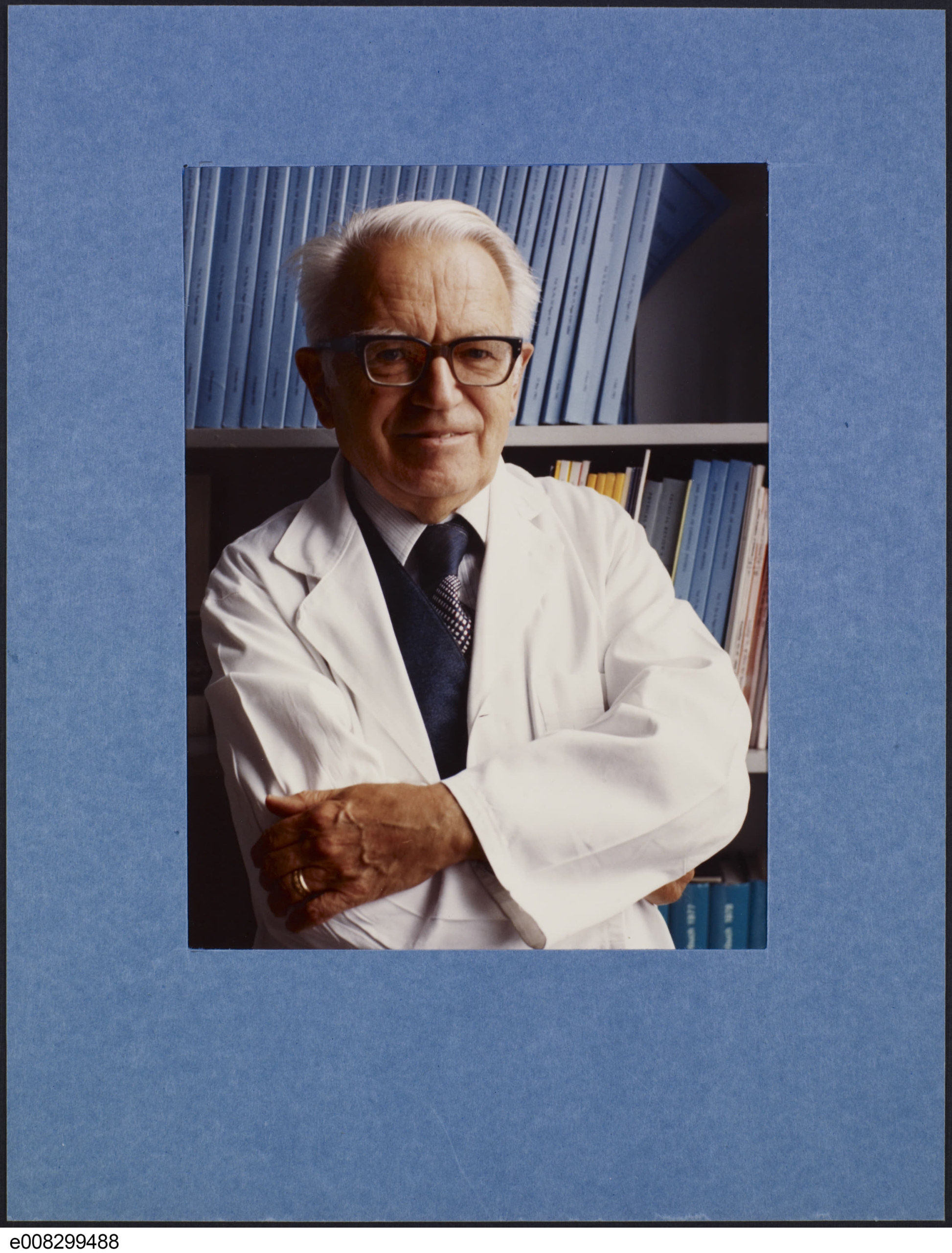
Dr. Gerhard Herzberg, Canadian scientist
Photograph
Image
Video
Audio
 Activities
LOOK
Research the life and contributions of Gerhard Herzberg, focusing on his scientific achievements, his work in Canada, and the challenges he faced as a refugee from Nazi Germany.
THINK
Reflect upon the impact of historical events (such as the Second World War) on scientific progress, and how Gerhard’s personal experiences may have shaped his career.
Consider the importance of diversity in science, and how contributions from people of different backgrounds enhance knowledge and innovation.
DO
Create a project or presentation on a scientific concept related to Herzberg’s fields of spectroscopy or molecular structure, explaining why his research was significant enough to win a Nobel Prize.
Details
 Date 1982
 Materials
 - Photograph
Historical Context
Choose one of the three levels below to match your needs.
- Photograph of scientist Gerhard Herzberg, who fled Nazi Germany with his Jewish wife in 1935.
- They settled in Canada, where he won a Nobel Prize for Chemistry in 1971.
- Refugees are an important part of Canadian society.
Photograph of scientist Gerhard Herzberg, who fled Nazi Germany with his Jewish wife in 1935.
Canada did not accept many refugees from Nazi Germany, barring entry to many seeking to escape persecution.
After coming to Canada, Gerhard’s groundbreaking research in chemistry won him a Nobel Prize. Canada’s highest scientific prize is named in his honour.
Refugees have contributed to Canadian society in many ways, big and small. Gerhard’s achievements only became possible when he found a safe haven.
Photograph of scientist Gerhard Herzberg, who fled Nazi Germany with his Jewish wife in 1935.
After being forced to leave Nazi Germany, Gerhard found a research position at the University of Saskatchewan, and went on to establish a major spectroscopic research laboratory at the National Research Council in Ottawa.
This work on the structure of molecules won him the Nobel Prize for Chemistry in 1971. His work also inspired the creation of the highest scientific honour in Canada: the Gerhard Herzberg Canada Gold Medal for Science and Engineering.
- Photograph of scientist Gerhard Herzberg, who fled Nazi Germany with his Jewish wife in 1935.
- They settled in Canada, where he won a Nobel Prize for Chemistry in 1971.
- Refugees are an important part of Canadian society.
Photograph of scientist Gerhard Herzberg, who fled Nazi Germany with his Jewish wife in 1935.
Canada did not accept many refugees from Nazi Germany, barring entry to many seeking to escape persecution.
After coming to Canada, Gerhard’s groundbreaking research in chemistry won him a Nobel Prize. Canada’s highest scientific prize is named in his honour.
Refugees have contributed to Canadian society in many ways, big and small. Gerhard’s achievements only became possible when he found a safe haven.
Photograph of scientist Gerhard Herzberg, who fled Nazi Germany with his Jewish wife in 1935.
After being forced to leave Nazi Germany, Gerhard found a research position at the University of Saskatchewan, and went on to establish a major spectroscopic research laboratory at the National Research Council in Ottawa.
This work on the structure of molecules won him the Nobel Prize for Chemistry in 1971. His work also inspired the creation of the highest scientific honour in Canada: the Gerhard Herzberg Canada Gold Medal for Science and Engineering.
Summary
- Photograph of scientist Gerhard Herzberg, who fled Nazi Germany with his Jewish wife in 1935.
- They settled in Canada, where he won a Nobel Prize for Chemistry in 1971.
- Refugees are an important part of Canadian society.
Essential
Photograph of scientist Gerhard Herzberg, who fled Nazi Germany with his Jewish wife in 1935.
Canada did not accept many refugees from Nazi Germany, barring entry to many seeking to escape persecution.
After coming to Canada, Gerhard’s groundbreaking research in chemistry won him a Nobel Prize. Canada’s highest scientific prize is named in his honour.
Refugees have contributed to Canadian society in many ways, big and small. Gerhard’s achievements only became possible when he found a safe haven.
In-Depth
Photograph of scientist Gerhard Herzberg, who fled Nazi Germany with his Jewish wife in 1935.
After being forced to leave Nazi Germany, Gerhard found a research position at the University of Saskatchewan, and went on to establish a major spectroscopic research laboratory at the National Research Council in Ottawa.
This work on the structure of molecules won him the Nobel Prize for Chemistry in 1971. His work also inspired the creation of the highest scientific honour in Canada: the Gerhard Herzberg Canada Gold Medal for Science and Engineering.