

Political Cartoon: "Bogus Refugee Claimants"
Document
Image
Video
Audio
 Activities
LOOK
Look closely at this political cartoon and complete the following sentences:
- I see . . . [Describe what you see in the political cartoon.]
- I think . . . [What do you think the political cartoon is trying to say?]
- I wonder . . . [What questions do you have about the political cartoon?]
THINK
Do you think this is an effective political cartoon? Why or why not?
DO
Create a political cartoon for an issue about which you feel passionate. What symbolism are you including to express your opinion?
Details
 Date December 30, 1988
 Materials
 - Paper
- Ink
Historical Context
Choose one of the three levels below to match your needs.
- This political cartoon attacks refugees to Canada by promoting false information.
- It demonstrates how messages about refugees and other migrants work, by dividing people and blaming refugees for things that are not their fault.
- A knowledge of anti-immigration politics in Canada would be beneficial, as would an ability to closely read images.
This political cartoon attacks refugees to Canada by promoting false information.
Some Canadians think that refugees receive more financial assistance from the government than Canadians in need, but this is not true.
Less than 4 percent of Canada’s social assistance spending goes to refugees, and the assistance for individual refugees is no more than that available to other Canadians in dire need. Based on provincial standards, it is a minimal amount, covering basic food and shelter.
This political cartoon attacks refugees to Canada by promoting false information.
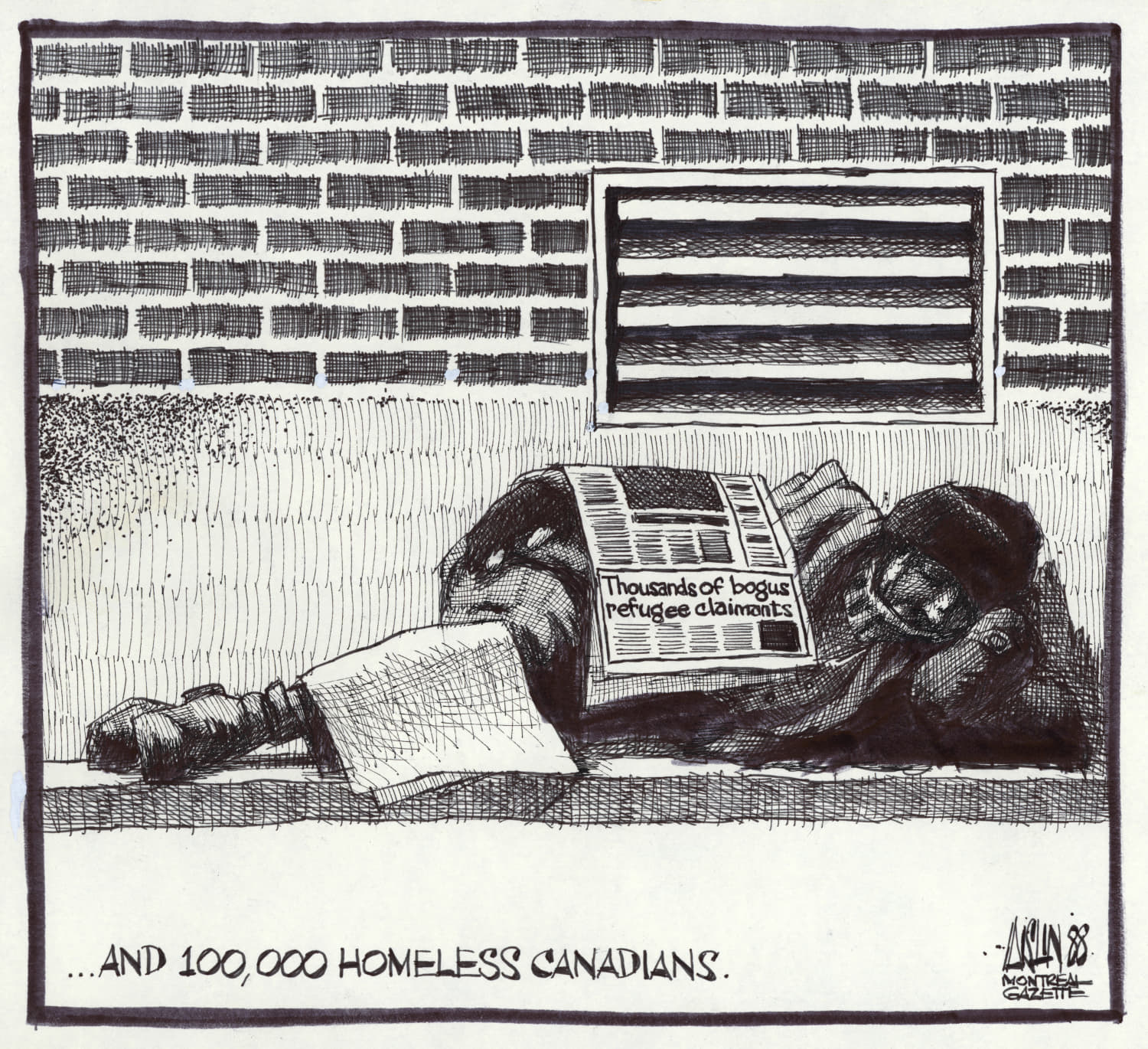
The cartoon depicts a man sleeping on the street, covered in newspapers reading, “Thousands of bogus refugee claimants.” The cartoon underscores a prevalent yet false belief: the government spends more money on refugees than on Canadians. In fact, less than 4 percent of Canada’s social assistance spending goes to refugees.
Published in 1988, the cartoon echoes the perception of some Canadians that the government is not helping citizens first. The cartoon reveals how anti-immigrant messages can enter public discussions.
Messages like this are powerful: they divide people into “us” and “them,” and blame others for things that are not their fault.
- This political cartoon attacks refugees to Canada by promoting false information.
- It demonstrates how messages about refugees and other migrants work, by dividing people and blaming refugees for things that are not their fault.
- A knowledge of anti-immigration politics in Canada would be beneficial, as would an ability to closely read images.
This political cartoon attacks refugees to Canada by promoting false information.
Some Canadians think that refugees receive more financial assistance from the government than Canadians in need, but this is not true.
Less than 4 percent of Canada’s social assistance spending goes to refugees, and the assistance for individual refugees is no more than that available to other Canadians in dire need. Based on provincial standards, it is a minimal amount, covering basic food and shelter.
This political cartoon attacks refugees to Canada by promoting false information.
The cartoon depicts a man sleeping on the street, covered in newspapers reading, “Thousands of bogus refugee claimants.” The cartoon underscores a prevalent yet false belief: the government spends more money on refugees than on Canadians. In fact, less than 4 percent of Canada’s social assistance spending goes to refugees.
Published in 1988, the cartoon echoes the perception of some Canadians that the government is not helping citizens first. The cartoon reveals how anti-immigrant messages can enter public discussions.
Messages like this are powerful: they divide people into “us” and “them,” and blame others for things that are not their fault.
Summary
- This political cartoon attacks refugees to Canada by promoting false information.
- It demonstrates how messages about refugees and other migrants work, by dividing people and blaming refugees for things that are not their fault.
- A knowledge of anti-immigration politics in Canada would be beneficial, as would an ability to closely read images.
Essential
This political cartoon attacks refugees to Canada by promoting false information.
Some Canadians think that refugees receive more financial assistance from the government than Canadians in need, but this is not true.
Less than 4 percent of Canada’s social assistance spending goes to refugees, and the assistance for individual refugees is no more than that available to other Canadians in dire need. Based on provincial standards, it is a minimal amount, covering basic food and shelter.
In-Depth
This political cartoon attacks refugees to Canada by promoting false information.
The cartoon depicts a man sleeping on the street, covered in newspapers reading, “Thousands of bogus refugee claimants.” The cartoon underscores a prevalent yet false belief: the government spends more money on refugees than on Canadians. In fact, less than 4 percent of Canada’s social assistance spending goes to refugees.
Published in 1988, the cartoon echoes the perception of some Canadians that the government is not helping citizens first. The cartoon reveals how anti-immigrant messages can enter public discussions.
Messages like this are powerful: they divide people into “us” and “them,” and blame others for things that are not their fault.