

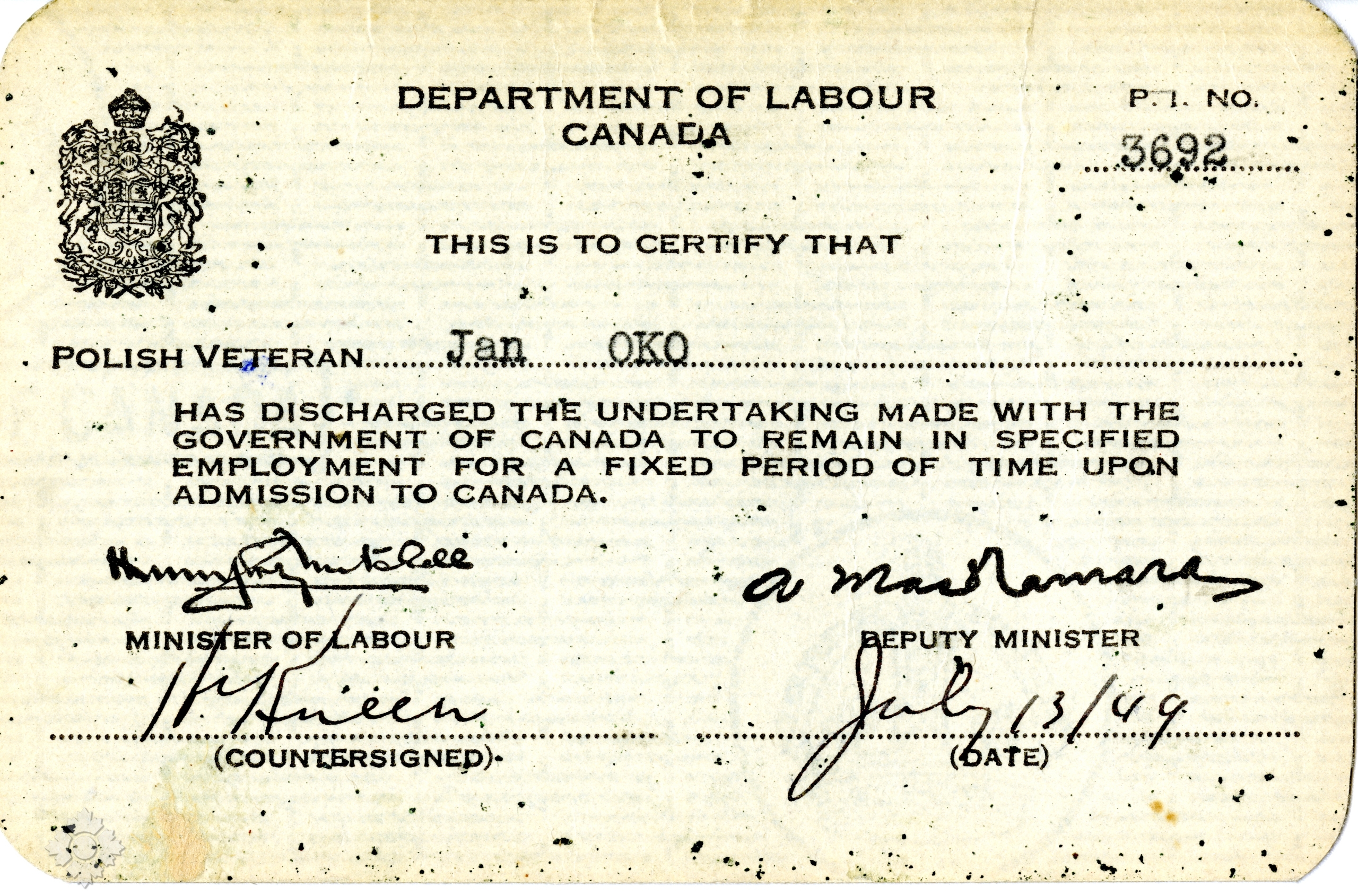
Polish Veteran ID Card
Artifact
Image
Video
Audio
 Activities
LOOK
Look at the Polish veteran’s ID card. What information is listed?
THINK
Reflect upon why Polish veterans were treated with suspicion, despite the role they played in liberating Europe. How do immigration policies reflect national values?
DO
Research Canada’s postwar labour program for agriculture. What were the requirements? Who did it recruit/accept? How successful was it?
Details
 Date July 13, 1949
 Materials
 - Paper
- Ink
Historical Context
Choose one of the three levels below to match your needs.
- This worker’s identification card belonged to an Allied veteran unable to return to his native Poland after the Second World War.
- As “displaced persons,” soldiers such as Jan Oko searched desperately for a country to call home. Despite fighting for the Allies, Jan and his fellow veterans were only able to enter Canada as farm workers.
- The ID card indicates how the government viewed refugees at the time: by how much they could give to Canada.
- More context can be gained by reading about the Soviet occupation of Poland after the Second World War, and the general history of displaced persons (DPs) in post-war Europe.
This worker’s identification card belonged to an Allied veteran unable to return to his native Poland after the Second World War.
Jan Oko fought Nazi Germany for his native Poland during the Second World War. He fled the Soviet occupation of his country, and became a “displaced person” — first in England, then in Canada.
Jan is one of thousands of Roman Catholic Polish veterans who eventually came to Canada as “qualified agricultural workers.” Predominantly Protestant Canada viewed non-English-speaking Catholic “foreigners” with suspicion.
Millions of people were displaced in post-Second World War Europe, often trapped on one side or the other of the East-West divide. Jan’s modest work permit is evidence of the hard labour many displaced people agreed to do in order to reach a place of relative safety.
This worker’s identification card belonged to an Allied veteran unable to return to his native Poland after the Second World War.
Polish soldiers had fought to liberate Italy and France during the Second World War, but faced imprisonment or execution if they returned to Soviet-occupied Poland after the fighting was over.
Canadian officials were reluctant to accept them, and some Canadians were suspicious because many of the Poles were Roman Catholic, at a time when Canada was predominantly Protestant.
Canada eventually accepted 4,527 Polish veterans as “qualified agricultural workers,” as long as the United Kingdom paid for their resettlement. These veterans had to compete for labour contracts before becoming landed immigrants, but the exception proved successful.
Jan Oko was born in a small Polish village. In 1940, the Soviet army entered the village and forced his family and others into cattle cars, which took them to Siberian gulags and concentration camps.
In 1942, Jan was able to join up, fighting with the Polish army as a gunner. When the Second World War ended, Jan travelled to England to live in a displaced persons camp. He decided to start a new life in Canada, and arrived at Pier 21 on May 25, 1947 as part of Canada’s labour program for agriculture. He worked for a farmer in Alberta for two years, then moved to Ontario to start his own family.
- This worker’s identification card belonged to an Allied veteran unable to return to his native Poland after the Second World War.
- As “displaced persons,” soldiers such as Jan Oko searched desperately for a country to call home. Despite fighting for the Allies, Jan and his fellow veterans were only able to enter Canada as farm workers.
- The ID card indicates how the government viewed refugees at the time: by how much they could give to Canada.
- More context can be gained by reading about the Soviet occupation of Poland after the Second World War, and the general history of displaced persons (DPs) in post-war Europe.
This worker’s identification card belonged to an Allied veteran unable to return to his native Poland after the Second World War.
Jan Oko fought Nazi Germany for his native Poland during the Second World War. He fled the Soviet occupation of his country, and became a “displaced person” — first in England, then in Canada.
Jan is one of thousands of Roman Catholic Polish veterans who eventually came to Canada as “qualified agricultural workers.” Predominantly Protestant Canada viewed non-English-speaking Catholic “foreigners” with suspicion.
Millions of people were displaced in post-Second World War Europe, often trapped on one side or the other of the East-West divide. Jan’s modest work permit is evidence of the hard labour many displaced people agreed to do in order to reach a place of relative safety.
This worker’s identification card belonged to an Allied veteran unable to return to his native Poland after the Second World War.
Polish soldiers had fought to liberate Italy and France during the Second World War, but faced imprisonment or execution if they returned to Soviet-occupied Poland after the fighting was over.
Canadian officials were reluctant to accept them, and some Canadians were suspicious because many of the Poles were Roman Catholic, at a time when Canada was predominantly Protestant.
Canada eventually accepted 4,527 Polish veterans as “qualified agricultural workers,” as long as the United Kingdom paid for their resettlement. These veterans had to compete for labour contracts before becoming landed immigrants, but the exception proved successful.
Jan Oko was born in a small Polish village. In 1940, the Soviet army entered the village and forced his family and others into cattle cars, which took them to Siberian gulags and concentration camps.
In 1942, Jan was able to join up, fighting with the Polish army as a gunner. When the Second World War ended, Jan travelled to England to live in a displaced persons camp. He decided to start a new life in Canada, and arrived at Pier 21 on May 25, 1947 as part of Canada’s labour program for agriculture. He worked for a farmer in Alberta for two years, then moved to Ontario to start his own family.
Summary
- This worker’s identification card belonged to an Allied veteran unable to return to his native Poland after the Second World War.
- As “displaced persons,” soldiers such as Jan Oko searched desperately for a country to call home. Despite fighting for the Allies, Jan and his fellow veterans were only able to enter Canada as farm workers.
- The ID card indicates how the government viewed refugees at the time: by how much they could give to Canada.
- More context can be gained by reading about the Soviet occupation of Poland after the Second World War, and the general history of displaced persons (DPs) in post-war Europe.
Essential
This worker’s identification card belonged to an Allied veteran unable to return to his native Poland after the Second World War.
Jan Oko fought Nazi Germany for his native Poland during the Second World War. He fled the Soviet occupation of his country, and became a “displaced person” — first in England, then in Canada.
Jan is one of thousands of Roman Catholic Polish veterans who eventually came to Canada as “qualified agricultural workers.” Predominantly Protestant Canada viewed non-English-speaking Catholic “foreigners” with suspicion.
Millions of people were displaced in post-Second World War Europe, often trapped on one side or the other of the East-West divide. Jan’s modest work permit is evidence of the hard labour many displaced people agreed to do in order to reach a place of relative safety.
In-Depth
This worker’s identification card belonged to an Allied veteran unable to return to his native Poland after the Second World War.
Polish soldiers had fought to liberate Italy and France during the Second World War, but faced imprisonment or execution if they returned to Soviet-occupied Poland after the fighting was over.
Canadian officials were reluctant to accept them, and some Canadians were suspicious because many of the Poles were Roman Catholic, at a time when Canada was predominantly Protestant.
Canada eventually accepted 4,527 Polish veterans as “qualified agricultural workers,” as long as the United Kingdom paid for their resettlement. These veterans had to compete for labour contracts before becoming landed immigrants, but the exception proved successful.
Jan Oko was born in a small Polish village. In 1940, the Soviet army entered the village and forced his family and others into cattle cars, which took them to Siberian gulags and concentration camps.
In 1942, Jan was able to join up, fighting with the Polish army as a gunner. When the Second World War ended, Jan travelled to England to live in a displaced persons camp. He decided to start a new life in Canada, and arrived at Pier 21 on May 25, 1947 as part of Canada’s labour program for agriculture. He worked for a farmer in Alberta for two years, then moved to Ontario to start his own family.