Microfade testing at the Canadian Museum of History
This article describes a new testing device used in the Canadian Museum of History’s conservation work. It allows conservators to determine how sensitive an item is to light. This is important because light can fade colours and cause damage over time. We can make better decisions about how to display items from our collection when we know how sensitive they are to light.
Introducing the newest member of the Canadian Museum of History’s conservation team: the Instytut Fotonowy Micro Fading Tester! During the summer of 2024, we received and began operating our first on-site microfade testing device.
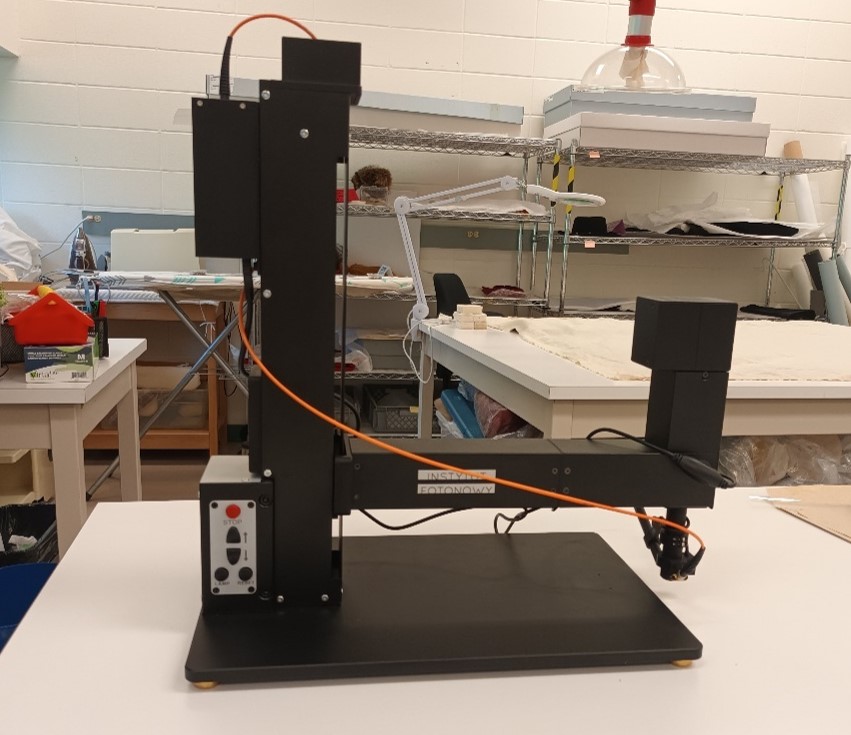
Instytut Fotonowy Micro Fading Tester – scientific grade.
Photo: Canadian Museum of History
What is microfade testing?
Microfade testing (MFT) is a practice that allows conservators and conservation scientists to test the light sensitivity of different materials and colourants. MFT has a number of advantages over previous approaches:
- The measurement equipment is portable, so it can take place in-situ.
- It doesn’t require exposing large areas of the object to potentially damaging light.
- It is much faster.
Earlier methods of testing placed samples below fluorescent lamps for several days. The samples would be removed periodically to take readings and monitor the change in colour. They would then be compared to blue-wool (BW) standards provided by the International Standards Organization to determine their degree of lightfastness.
With the introduction of MFT technology in 1994 by conservation scientist Dr. Paul Whitmore of Carnegie Mellon University, conservators can now measure colour change information in minutes!
How do microfade testers work?
MFT devices expose a small area of the object — less than 1 mm in diameter — to a concentrated spot of light (4-7 Mlux) and track the colour change over time by measuring the reflected spectrum of colour.
The main components that make up an MFT are the lamp and spectrophotometer.
Both LED and xenon arc lamp light sources are used. While xenon arc lamps cover almost the entire visible spectrum (400-700nm), LEDs cover only a portion of it. This makes xenon arc lamps better for representing exposure to daylight and worst-case scenarios of light exposure. Since most exhibits at the Museum are illuminated with LED lighting, the less expensive and more stable LED light source is an acceptable option.
Colour change is measured by taking spectrophotometric reflectance readings. Spectrophotometers measure light intensity as a function of wavelength. The light from a test lamp is reflected to the spectrophotometer using a series of fiber optic cables and focusing lenses.
The readings are analyzed using the CIELAB color space developed by the International Commission on Illumination. In this space, colours are defined by:
- L* (lightness, from white to black)
- a* (red-green)
- b* (yellow-blue)
The distance between two colours in this space is denoted as ΔE, a numerical value that quantifies any colour change.
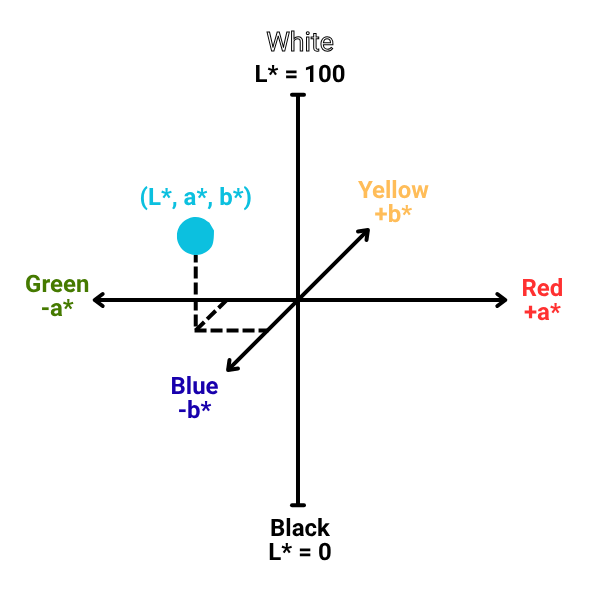
The CIELAB color space defines a colour based on coordinates L* for luminance (ranging from black to white), a* for red to green, and b* for yellow to blue.
Illustration: Canadian Museum of History (adapted from the Getty Conservation Institute).
Due to the varying light sources used in MFT testing, results are best analyzed comparatively against BW standards. After colour change values are produced for the object, they are assigned an approximate BW rating. This value can then be used to identify how long the item can remain on display under a certain intensity of light (measured in lux) before a just noticeable difference (JND) in colour can be perceived by a healthy human eye.
Estimated time to reach a just-noticeable difference when materials are exposed to non-UV light for 8 hours per day. (Adapted from the Getty Conservation Institute.)
| Illuminance | High-sensitivity material | Medium-sensitivity material | Low-sensitivity material |
|
50 lux (dim lighting) |
1.5 to 20 years | 20 to 700 years | 300 to 7000 years |
|
150 lux (moderate home lighting) |
0.5 to 7 years | 7 to 200 years | 100 to 2000 years |
|
500 lux (bright office or task lighting) |
7.5 weeks to 2 years | 2 to 70 years | 30 to 700 years |
How do we use microfade testing?
Various objects comprised of all sorts of materials and colourants come through the conservation labs every day. It’s not always known what exactly they’re made of and how much light damage they may have already received. Conservators can often estimate the light sensitivity of an object by examining the types of colourants and materials used. But MFT is a great tool to refine this estimate and quantify approximate light intensity to duration ratios. These values help conservators and curators make informed decisions on lighting and exhibition duration to avoid unwanted deterioration of collections materials.
In August of 2024, the Museum undertook a large microfade project in partnership with the Canadian Conservation Institute (CCI) to test several objects from the Museum’s First Peoples Hall. Various objects ranging from gloves, to baskets, to garments were microfaded to add BW equivalencies to their conservation profiles and inform decisions about their continued display.
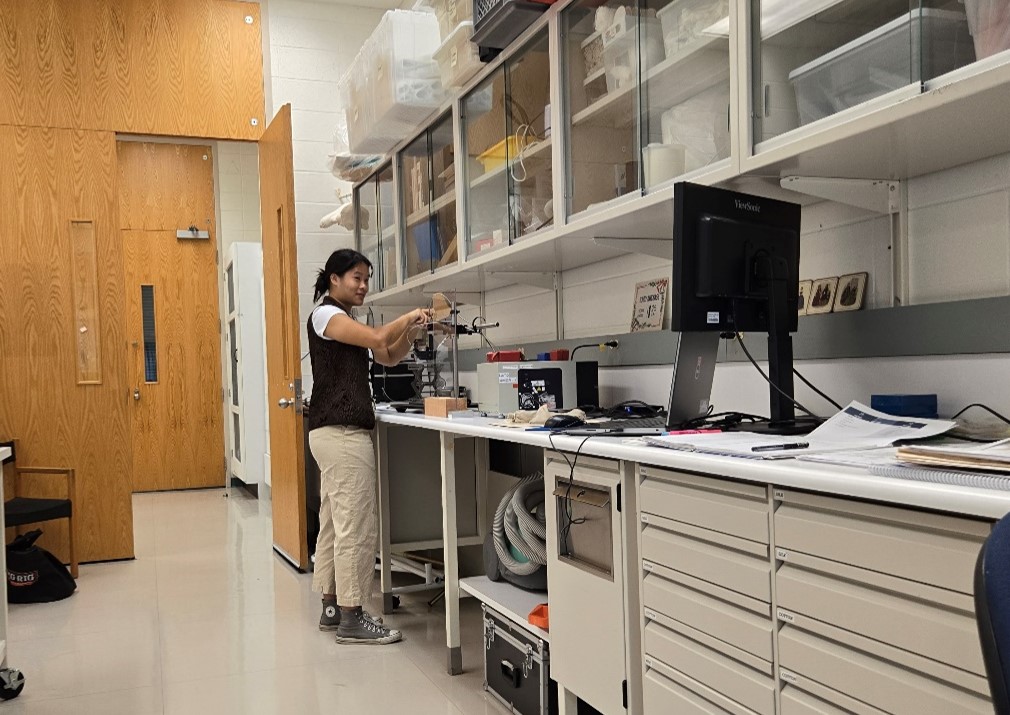
Quynh-Ni Au operating the CCI’s APEX-MFT.
Photo: Maeve Moriarty/CCI
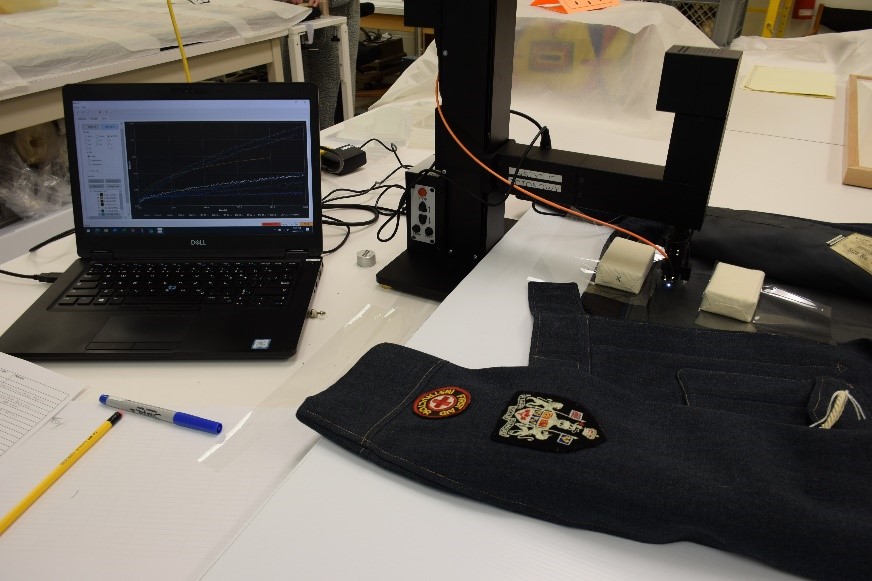
Instytut Fotonowy Micro Fading Tester performing a test on RCAF cadet jacket for Ingenium.
Photo: Quynh-Ni Au. Jacket: Ingenium, no. 2024.0002.
Some objects from the First Peoples’ Hall had been previously microfaded using the CCI’s APEX-MFT device. Repeating the tests a few years later helps to verify if the lighting decisions made in previous years were appropriate. Conservators can see if the object underwent any noticeable fading by comparing the test results and by verifying if the sensitivity of the object remained the same. As colourants fade, they become less light sensitive, so a similar light sensitivity result after a few years tells us that the colourant has not faded significantly, if at all.
Comparison to the APEX-MFT
These tests were a great opportunity to compare our new Instytut Fotonowy MFT to the CCI’s APEX-MFT. The final step in getting the Instytut Fotonowy up and running was to ensure that we could achieve similar BW equivalence values for the same object on both devices.
The APEX -MFT uses a xenon-arc lamp as its light source and is made of individually sourced components.
In contrast, the Instytut Fotnowy MFT uses an LED light source and features a slimmer profile and simpler user experience. With a shorter warm-up time and a smaller profile, the Instytut Fotnowy MFT is portable! It can be mounted on a tripod to assess large objects in situ with a short set-up time.
The APEX-MFT can achieve spot sizes of approximately 0.3 mm, whereas the Instytut Fotonowy uses larger spot sizes of 0.61-0.65 mm. The smaller spot size allows for greater precision of positioning (for example, on top of a weave strand or small bead). But it also means that any slight movement of the object or machine can shift the light spot significantly.
The larger spot size reduces its precision, but we found that it allows for greater tolerances to small movements or vibrations. It can also average the surface colour for objects that have more surface texture, such as silk crepeline or very fine weaves, avoiding measurement errors.
In the end, we were able to replicate similar BW equivalence values with both devices. Our microfade project was a success!

Quynh-Ni Au
Quynh-Ni Au is a bachelor’s student in the Biomedical Mechanical Engineering and Computing Technology program at the University of Ottawa. She worked as a summer student with the Collections Division during the summer of 2024 and is passionate about conservation science.