Napoleon at the Museum
Napoleon Bonaparte remains a fascinating and charismatic figure more than two centuries after his death.
Nicknamed the “Little Corporal,” he was born into the minor nobility of Corsica but managed to rise to the highest levels of the French government. A brilliant tactician, he fought for the Republic during the French Revolution. His innovative strategies earned him victory after victory, bringing him both fame and prestige. His growing military authority enabled him to seize political power and, eventually, crown himself Emperor of France.
The Canadian Museum of History dedicated two exhibitions to him: Napoleon and Paris in 2016–2017 and Napoleon – The Immersive Saga in 2026–2027. Our collections, along with those of the Canadian War Museum, contain a variety of artifacts that bear witness to the Emperor’s political and cultural influence around the world, including here in Canada.
The collections contain multiple artifacts dating back to the Napoleonic period, including a handful of British and French weapons, but a few exceptional pieces stand out from the rest. Here are five highlights that showcase Napoleon’s place in Canadian history and illustrate an epic tale that, some 200 years later, still stirs the imagination.
A souvenir from the last battle
This drum is said to have been taken at the Battle of Waterloo. The attribution remains impossible to confirm, but it is plausible. The construction of the instrument — a snare drum with a brass shell and wooden hoops drilled to accommodate a rope tensioning system — is indeed consistent with French models of the time.
It was acquired in Brussels in the summer of 1926 by Dr. Harold Murchison Tovell, a radiologist from a prominent Toronto family and the husband of Ruth Lillian Massey, a cousin of Vincent Massey, who would later become Governor General of Canada.
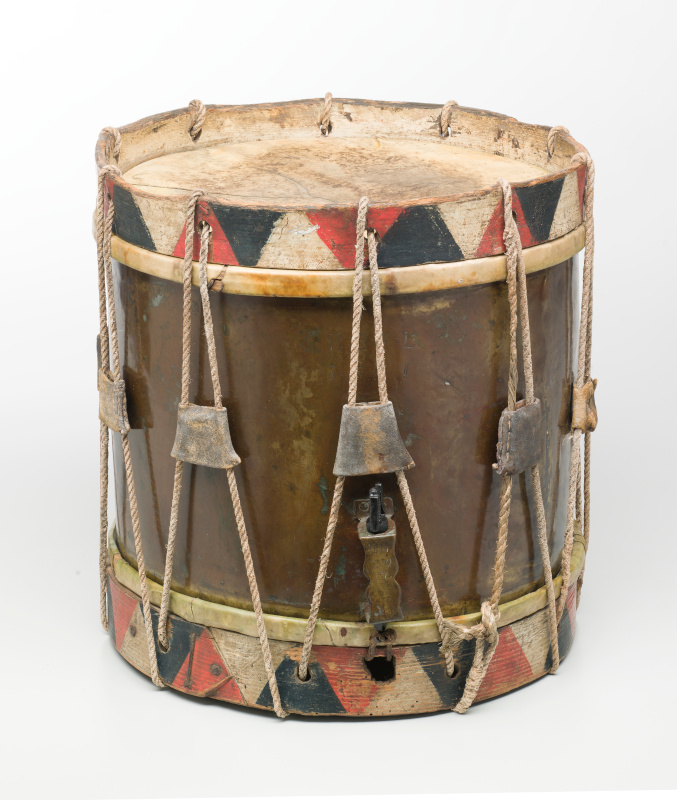
French drum, approximately 1810–1815.
Canadian War Museum, 19790679-001.
The man in the hat
After the Napoleonic Wars, Napoleon became a figure of folklore. This full-size sculpture, carved from pine and retaining its original polychrome paint, dates from the first half of the 19th century. Oral tradition claims it is the work of Michael Grace, a shipbuilder in Sackville, New Brunswick, who was a sculptor in his spare time. It is said to have once stood at Tingley House, a stagecoach stop in the area.
However, our latest research has not confirmed the sculptor’s identity or pinpointed the exact location of this site. An object like this illustrates both the persistence of certain gaps in museum collections and Napoleon’s significance as an icon of popular culture.
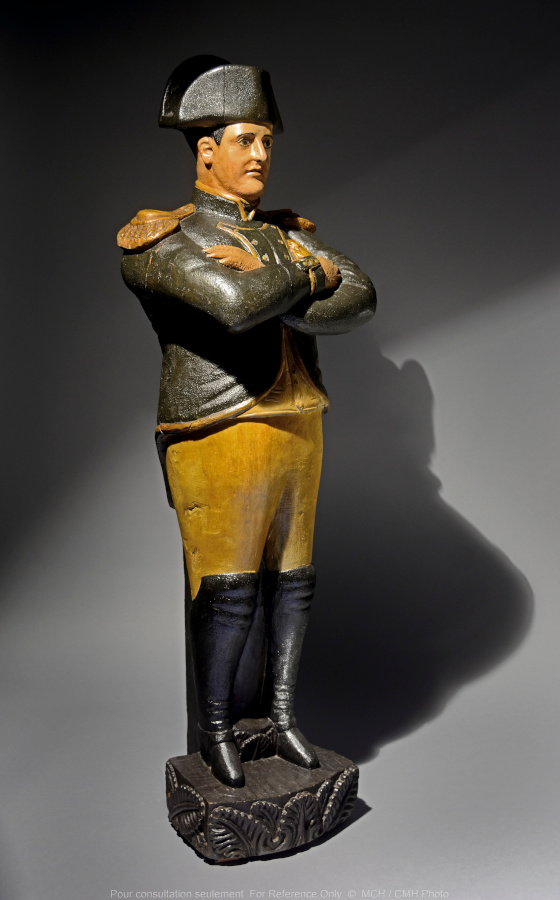
Statue of Napoleon, polychrome pine, attributed to Michael Grace, approximately 1815–1850.
Canadian Museum of History, 2007.22.94.
The medal of a great explorer
Several soldiers and sailors from the British Army and Navy settled or stayed for a period in North American colonies after the Napoleonic Wars. Among the most famous figures is Sir John Franklin. Born in 1786, he joined the Royal Navy at a very young age and took part in the major naval campaigns of the time, including the Battle of Trafalgar in 1805.
He later distinguished himself as the leader of expeditions to map the Arctic and search for the Northwest Passage. In 1845, he led a final expedition that ended with the loss of his ships and his own death, cementing his tragic reputation. This Naval General Service Medal was awarded to him posthumously, likely at the request of his widow, Lady Franklin.
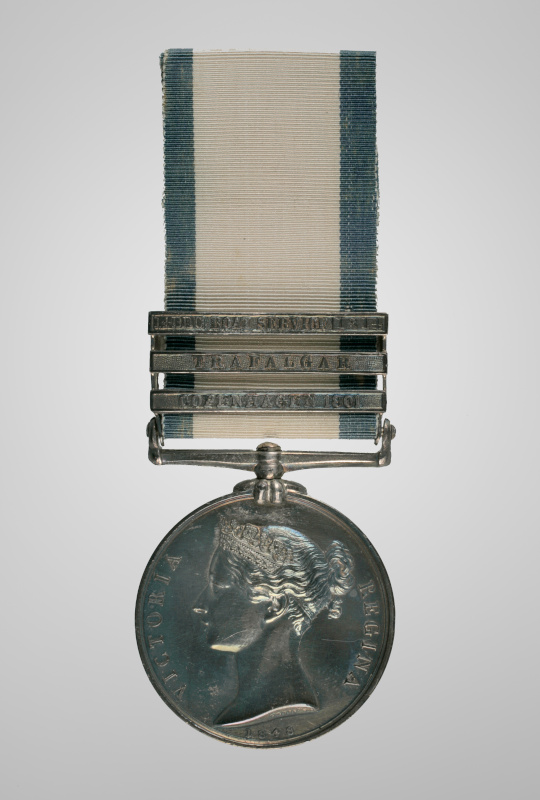
Naval General Service Medal, Hunt & Roskell, 1847, Inscription: “SIR JOHN FRANKLIN, LIEUT. R.N.”
Canadian War Museum, 19810018-001.
The Emperor in song
Napoleon has long held a special place in the memories of French Canadians and Acadians. Even in defeat, he embodies the greatness of France and the influence of its culture. His legacy is reflected in the enduring popularity of the first names “Napoleon” and “Josephine” until the mid-20th century. He is also found in the repertoire of traditional songs.
Our archives contain, in the form of recordings and transcripts, a dozen songs about the Emperor. This one, for example, titled “Napoléon à Sainte-Hélène” (Napoleon at Saint Helena) or “Du temps que j’étais empereur” (Back When I Was Emperor), was collected by folklorist Marius Barbeau from Marie-Ange Dionne (née Breton) of Montréal in 1918.
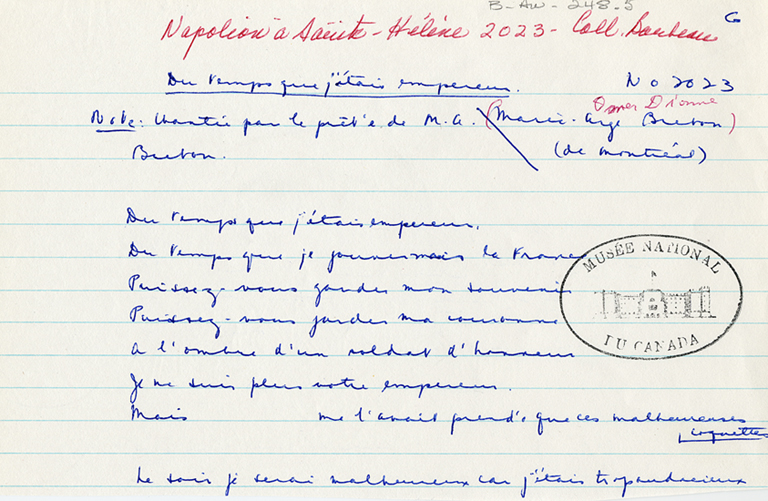
“Napoléon à Sainte-Hélène”, 1918.
Barbeau Collection. Canadian Museum of History, B-Aw-248.5.
A famous impersonator
One could easily mistake this portrait for one of Napoleon, what with the hairstyle and the hand tucked into the vest. Yet this is Louis-Hippolyte Lafontaine, a major figure in Canadian politics.
Proud of his resemblance to the Emperor, Lafontaine made a point of emphasizing it. The intellectual and legal framework within which he worked — and to which he himself contributed — was, in fact, shaped by Napoleonic reforms.
After a distinguished political career, notably as premier of the Province of Canada, he was appointed chief justice of Lower Canada. The influence of the Napoleonic Code on the Civil Code of Québec — adopted in 1865, one year after his death — was decisive: it helped preserve the province’s distinct character in the face of British political domination.
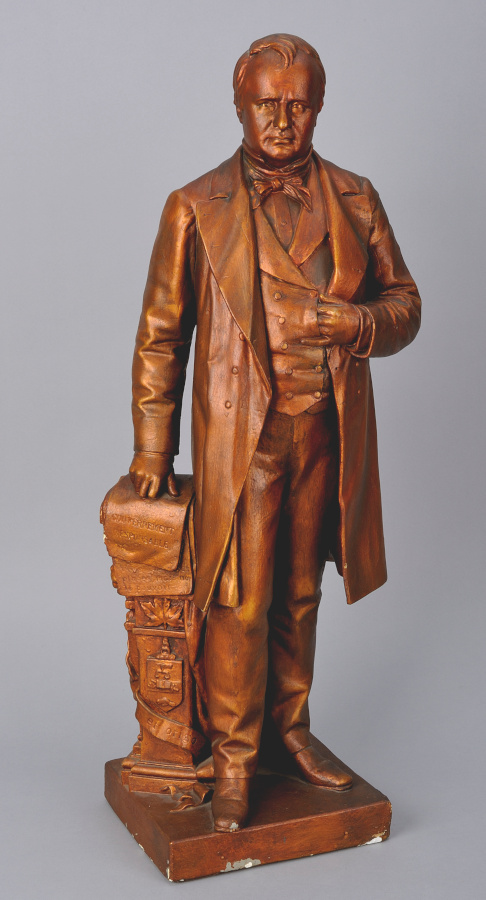
Louis-Hippolyte Lafontaine, by Louis Hébert, patinated plaster, approximately 1882–1897.
Canadian Museum of History, D-2480.
To explore our collections yourself — whether in search of Napoleon or for any other topic — take a look at the online catalogues of the Canadian Museum of History and the Canadian War Museum.

Jean-François Lozier
Jean-François Lozier has been Curator of French North American history at the Museum since 2011. His research focuses primarily on French-Indigenous relations during the 17th and 18th centuries, Early Canadian material culture in all its forms, and memory and commemoration of this period.
Read full bio of Jean-François Lozier