Eliminating plastics in museum storage: Truly a good idea?
During the 1980s, traditional storage materials (made of cellulose and other substances) were replaced by plastic in the Canadian Museum of History’s collections.
It was argued that this change had many advantages, such as better protection of objects against insects, mould, and water damage. It was also argued that plastics could support and cushion collections materials at a better price point. Plastics were enthusiastically adopted as the default storage materials at the Museum.
Over the course of four decades of use, however, we have seen plastics degrade. This has negative effects on collection objects and the environment. These concerns have counterbalanced the previous enthusiasm to the point that the Museum is now seeking to remove almost all plastics from its storage.
What is plastic?
Plastic is a general term which refers to synthetic materials made of polymers or copolymers, mainly based on hydrocarbons. Their characteristics vary because they are made from different base molecules. Various additives, such as pigments, are also used to modify or colour the products.
The plastics recommended for the purposes of the collection are those with the best physical and chemical properties and whose compositions are as stable as possible. They are therefore non-biodegradable. However, they are still vulnerable to degradation by environmental factors such as oxygen, heat, and ultraviolet light. These factors, in conjunction with the migration of additives within their structure, contribute to chemical and physical breakdown.
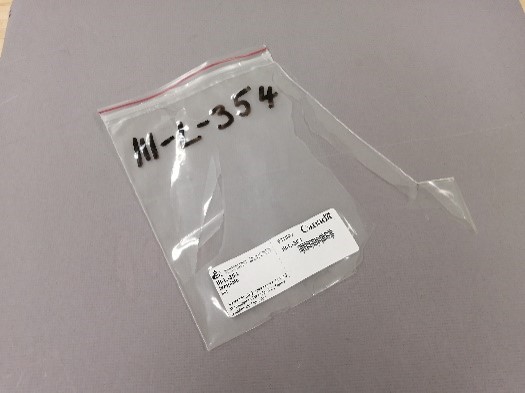
An example of deterioration: this polyethylene bag has fragmented.
Photo: Canadian Museum of History
This damage will generally result in yellowing. It can also weaken the material, leading to sagging, cracking, shrinkage, and partial or complete fragmentation. When additives ooze out, plastic surfaces can become sticky and smelly. The degradation of polymers can also release acid fumes or volatile organic compounds (VOCs).
How are plastics being used?
The plastics found in collections storage can be divided into four main use cases. Through one or more of these use cases, most of the collection is in contact with plastic.
Containers
Containers such as boxes or bins, bags or pouches, allow the storage of objects and help avoid unnecessary handling. Containers allow for optimization of storage space through stacking (Schaeffer boxes for example). They also help protect objects from the effects of condensation, insect activity, dust, light, and handling. And finally, plastic containers help isolate and contain pesticides or mould.
Interfaces
Interfaces are layers that separate objects from shelves, drawers, boxes and supports. They reduce friction between different parts of an object or between an object and a support or container. Interfaces reduce or prevent slippage on smooth surfaces such as shelves or containers. They also create a barrier against the release of VOCs, for example between an object and a wooden surface. And they can help prevent scratches on painted metal shelving, thus reducing the risk of corrosion.
Supports
Supports can be rigid or semi-rigid, sculpted, tubes, padding or quilting. Common uses of supports include:
- Maintaining the shape of objects
- Supporting flexible or fragile parts
- Relieving pressure points
- Better distributing the weight of an object
- Relieving wrinkles in flexible materials such as textiles, leather clothing, and baskets
Supports make it possible to limit direct manipulation and allow certain objects to be transported more safely.
Protective films
Protective films can be pliable or semi-rigid. They protect objects against dust, water damage, and insects. They help contain and limit the spread of pesticides or mould. Films also protect more delicate or lightweight components from unnecessary manipulation.
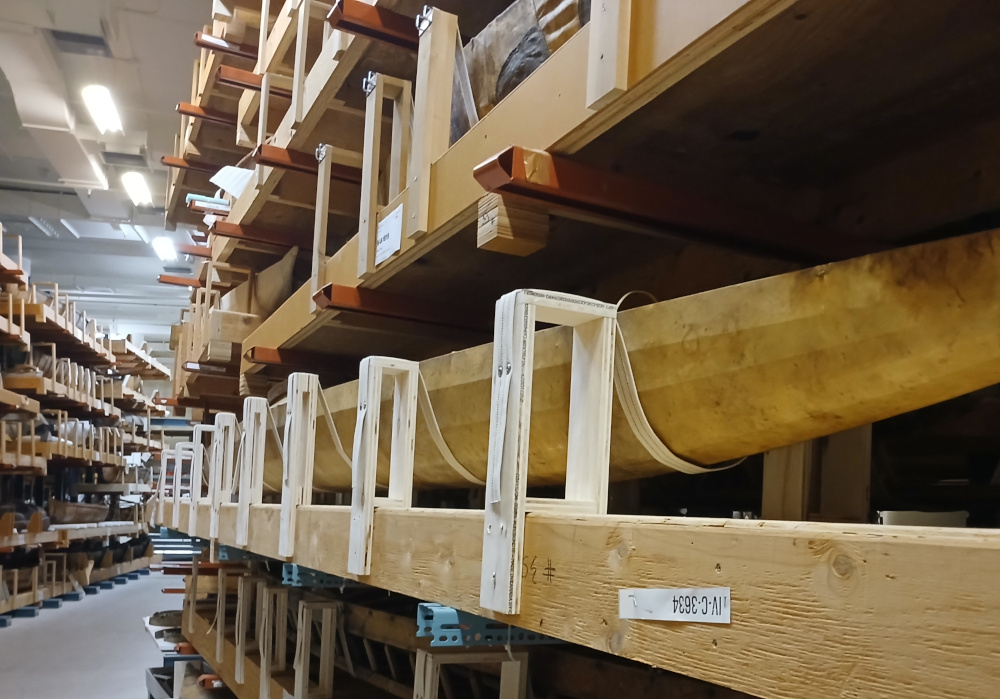
A creative solution for replacing some plastics in storage of watercraft.
Photo: Canadian Museum of History
What effects do plastics have?
The degradation of polymers can pose physical risks to the objects in the collection, including
- breakage or deformation resulting from a degraded support;
- dissociation (loss of components or mixing with other specimens); or
- mechanical contamination due to fragmentation of the polymer.
The risk of chemical contamination is also common and pernicious. This can modify the physical appearance of an object through discolouration or staining. It can also create sticky surfaces, adherence problems, and odors. Acid emissions or the migration of additives risk harming objects, for example causing corrosion of metals or degradation of paper.
Contamination can be caused by the release of VOCs from new as well as degraded polymer. In addition, storage in a plastic container can trap VOCs released by stored materials. In combination with those released by the container itself, these gases could have an exponential effect on the deterioration of the object.
The presence of micro fragments caused by migration of additives or release of VOCs can also negatively affect the study of the collection because these substances can corrupt the results of analysis.
Chemical contamination is often invisible. By the time the effects are seen, it may be too late to remedy the damage.
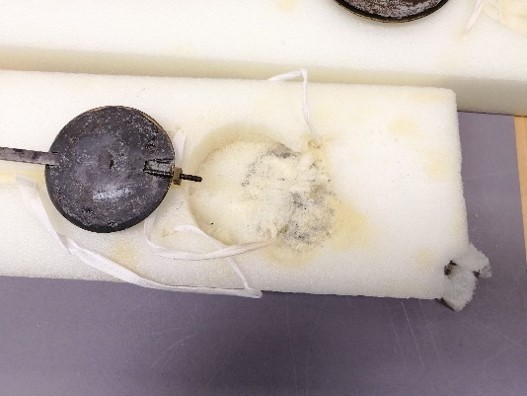
This plastic support has fragmented and discoloured. It has also caused corrosion of the metal object that was in contact with it.
Photo: Canadian Museum of History
What are alternatives to plastic?
Somewhat ironically, the materials most used today as alternatives to plastics are essentially those put aside in the 1980s.
Unfortunately, the contamination of these materials by pesticides or mould remains problematic. And the gradual acidification of some paper and cardboard products can cause deterioration of collections materials.
Traditional materials also don’t have a definitive environmental benefit. Some have carbon footprints equivalent to, or even greater than, that of plastics. Water, energy and chemicals are used in the production, processing and distribution of materials such as cardboard, paper or cotton. However, these materials seem more acceptable to us now since in theory they are recyclable or compostable.
The best alternative to using plastics seems to be to use nothing when possible. But what about, for example, protecting items in a cold chamber or preventing the spread of mould? How can the Museum contain pesticides without the use of plastics?
Is eliminating plastics in museum storage a good idea?
Choosing to eliminate the use of plastics for storing objects in the collection is, on balance, not only a “green” approach, but also a preservation measure. As we have seen, new or deteriorated plastics can have harmful effects on objects.
But for certain uses, the advantages of plastics are undeniable. It is necessary to carefully weigh the advantages and limitations of replacement materials. It does not always seem appropriate to completely eliminate or replace the plastics in our storage rooms.
Exploring this fundamental aspect of conservation requires common sense, creativity, collaboration, and the art of compromise. Being curious about new materials, techniques and research is necessary to find innovative solutions at a reasonable cost. Using these many skills and striking a balance to find the best solution in each case is what makes our profession so interesting.
This article summarizes a comprehensive 2021 study on the risks associated with the use of plastics in the storage of collections at the Canadian Museum of History. This report is available on request: email conservation@museedelhistoire.ca.

Caroline Marchand
Caroline holds master’s degrees in Conservation and Restoration of Cultural Property and in Historical Archeology - aspects of Conservation (University of Paris 1 Panthéon-Sorbonne). She specializes in the conservation treatment of three-dimensional objects. In addition to preservation for the preparation of exhibitions, loans or acquisitions, Caroline is also actively involved in conservation activities linked to repatriation and in supporting community cultural centers.