
1. Overview
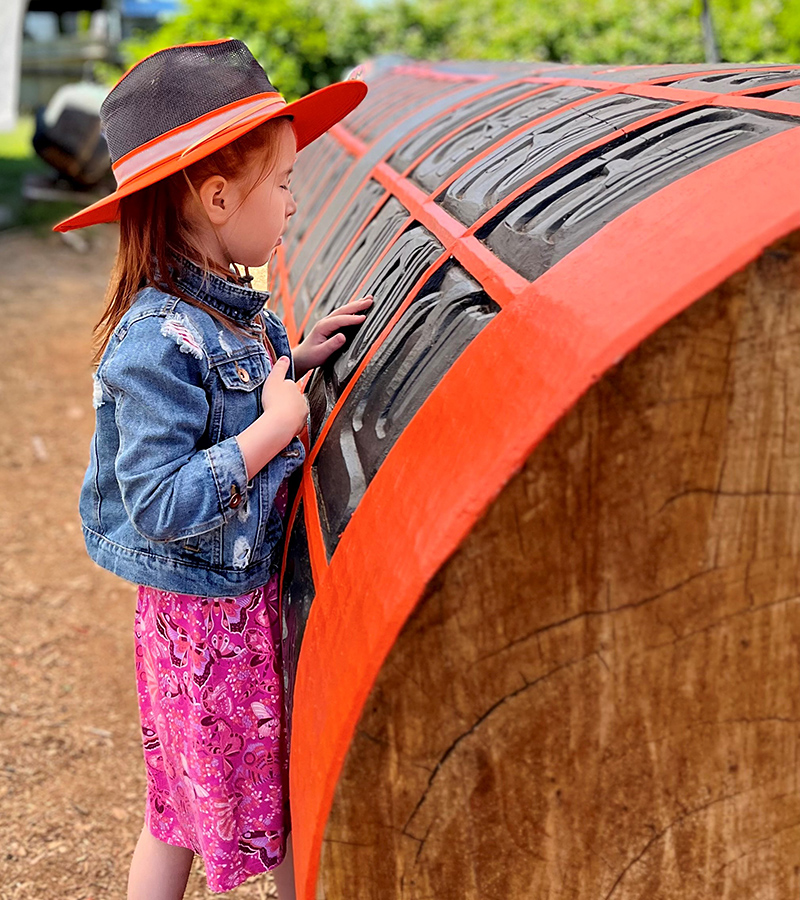
This lesson uses Visual Thinking Strategies (VTS) — a facilitation approach that invites students to pause, closely examine an image, and share their observations with the group. VTS emphasizes patterns of thinking rather than memorizing specific facts about a work of art. It supports careful observation, evidence-based interpretation, active listening, and respectful discussion. This activity is based on the monument itself and can be accompanied by the video Stanley C. Hunt: Carving Truth Into Memory, which is available on this webpage.
Grade levels: Kindergarten to Grade 12; Kindergarten to Secondary V in Quebec
- Estimated time: 30 minutes
- Curriculum connections: Social Studies, History, Language Arts, Media Arts, Visual Arts
2. Historical Thinking Concepts
- Evaluating evidence: What can we learn about how people lived by examining the clues they left behind? What questions remain?
- Historical significance: How do we decide which stories to tell, and whose stories are included? What evidence do we use, and what evidence might be left out?
3. Learning Objectives
Through a VTS-based interpretation of art or photographs, students will
- contribute to a classroom environment that supports thoughtful, compassionate and reflective conversations rooted in the principles of truth and reconciliation;
- examine Stanley C. Hunt’s Indian Residential School Memorial Monument in the Canadian Museum of History’s Four Seasons Salon, or through the Museum’s online learning module;
- develop new vocabulary;
- build confidence in verbal expression;
- practice active listening and make connections to others’ ideas;
- recognize that people may notice different details in the same work of art, and that sharing observations can reveal multiple perspectives; and
- extend learning from reflection into meaningful action in support of truth and reconciliation.
4. Materials Required
If the activity takes place on site:
- Access to Stanley C. Hunt’s Indian Residential School Memorial Monument in the Canadian Museum of History’s Four Seasons Salon.
If the activity takes place in the classroom:
- Video and images of Stanley C. Hunt’s Indian Residential School Memorial Monument, available on the Canadian Museum of History website.
- Exhibition: Indian Residential School Monument
- Learning Resource: National Day for Truth and Reconciliation
- Projector or interactive whiteboard.
5. Facilitation Tips for a VTS Session
VTS can be used with a wide range of artworks, illustrations and photographs. The following tips can help guide a thoughtful discussion, whether the focus is Stanley C. Hunt’s monument or another image.
Select images in advance.
- Begin with an image that feels accessible, such as one connected to a historical period your class has already studied.
- For a first session, select two images. In later sessions, you may use one to three images.
Allow students to build comfort through practice.
- Watch for signs that the group has finished reflecting on an image before moving to the next one.
- Early sessions may be brief. As students become more comfortable, discussion of a single image may last 20 minutes or more.
Do not expect perfection at the beginning.
- Each time you lead a VTS discussion, you will grow as a facilitator, and students will become more comfortable with the process.
- Over time, discussions can become longer, richer, and more thought-provoking.
- Allow students to take risks in their thinking while maintaining a space that supports reflection and accountability.
- Avoid correcting students immediately. Instead, use follow-up questions to invite them to explain their thinking.
- Give classmates opportunities to respond in ways that support shared learning. Even unexpected inferences can open valuable discussion.
Let the discussion develop naturally.
- Do not try to steer the conversation toward a pre-determined conclusion.
- The same artwork or photograph may lead to different discussions depending on the group.
6. Lesson Procedure
Part A: Introduction
At the beginning of the class, invite students to consider what it means to take part in conversational practices rooted in truth and reconciliation. Encourage them to reflect on what truth and reconciliation may mean to them individually and as a class. Together, establish discussion guidelines that support safe, respectful, reflective and accountable participation.
Next, introduce Visual Thinking Strategies. Explain that this approach invites students to look closely at art, share observations and ideas, listen to others, and build understanding together. Display the selected image and ask students to look at it silently for one minute before the discussion begins. Do not provide the title of the artwork or photograph at this stage, so students can begin with an open mind.
Part B: Questions
VTS discussions use specific facilitator questions in a specific sequence. Because wording matters, ask the questions as written. After students have examined the image, begin with:
- What’s going on in this picture? When a student makes an inference, paraphrase the comment in different words and ask: What do you see that makes you say that?
- To invite additional participation, ask regularly: What more can we find?
Tips for effective teacher facilitation
- Listen carefully and make sure you understand each student’s comment accurately.
- Point precisely to the area of the image being discussed.
- Use supportive body language and facial expressions to encourage participation.
- Paraphrase each comment by changing the wording while preserving the meaning.
- Use clear sentence structure and vocabulary to support students’ language development.
- Respond neutrally to each comment.
- Link related answers, including points of agreement and disagreement, to show how ideas can evolve through discussion.
Part C: Concluding the lesson
You will know that students have completed their reflection when they no longer offer new observations in response to “What more can we find?” and the discussion begins to return to the same ideas.
Thank students for their participation. Ask them to speak with a partner about what the lesson may inspire them to think about or do next. Invite a few students to share their reflections with the class. Encourage them to understand the viewing of art and photographs as an ongoing, open-ended process. If appropriate, dedicate time to discussing how students might support truth and reconciliation through learning from and with Stanley C. Hunt’s carved monument.
After the VTS portion of the lesson, and after any discussion of truth and reconciliation or the Calls to Action, you may ask students whether they would like more contextual information about the artwork. At that point, share the background information provided, if you wish. This exercise can be repeated regularly to strengthen students’ observation, listening, interpretation, and discussion skills.
National Day for Truth and Reconciliation – Learning Resource
We invite you to engage in prepared learning resources rooted in truth and reconciliation principles, and what it means to be a witness in understanding the ongoing legacy of the Indian Residential School System and its function in Canada.
Learn more